
Pet medical records to keep

The pet medical records worth keeping are: vaccination records (with dates and when each is next due), the rabies certificate, your pet’s microchip number and the registry it is on, a list of current medicines and doses, any allergies or reactions, recent lab results, a short history of illnesses and operations, and your pet insurance details. Keep them for your pet’s whole life, with a copy on your phone and the originals in one folder.
Your vet keeps records too, but they live at one practice. When you move, see an emergency vet at 2 a.m., leave your pet with a sitter or travel abroad, your own copy is the one that counts.
The checklist
| Record | Why you need it | Keep |
|---|---|---|
| Vaccination record | Proof of protection for kennels, groomers, daycare and travel; tells a new vet what is due | Every vaccine, date given, product and next due date |
| Rabies certificate | Often a legal requirement, and needed for travel | The signed original, plus a scan |
| Microchip number | Reunites a lost pet; needed for travel documents | The chip number (usually 15 digits), the registry name and your login |
| Current medicines | Prevents dangerous gaps or doubling up in an emergency | Name, strength, dose, how often, what it’s for, prescribing vet |
| Allergies and reactions | Avoids repeating a drug, vaccine or food that caused a problem | What, when, and what happened |
| Lab results | Gives a baseline to compare against, especially in older pets | Bloodwork, urine tests, biopsy reports, with dates |
| Imaging | Saves repeating X-rays or scans | Reports, and images if the practice can share them |
| Illness and surgery history | Context for any new problem | Diagnoses, operations, dates, which practice |
| Spay or neuter record | Licensing, some kennels, travel paperwork | The date and practice |
| Parasite prevention | Shows what was given and when it is due again | Flea, tick, worm and heartworm products and dates |
| Weight history | Gradual weight change is an early sign of illness | A weight at every visit, or monthly at home |
| Insurance | Speeds up claims and emergency approvals | Policy number, insurer’s phone number, what is covered |
| Identity and ownership | Proves the pet is yours if they go missing | Adoption or purchase papers, registration, a recent photo of you together |
| Contacts | For a sitter, a family member or an emergency vet | Your vet, the nearest 24-hour emergency clinic, a backup contact |
Vaccination records
Ask for the date given, the vaccine name (or the product label sticker) and the next due date for each one. Many vaccines are not yearly, so “last year’s vaccines” is not enough to work out what is due now. For schedules, see the puppy, adult dog, kitten and adult cat guides.
The rabies certificate
Where rabies vaccination is required by law, the signed certificate is your proof. It records the vaccine, the batch, the date and how long it is valid. You will need it for licensing in many places, for boarding, and for almost any international travel. Keep the original paper copy, because some offices and border checks won’t accept a photo.
Microchip
A microchip only works if the registry has your current details. Note the chip number and which database it is registered with, and update your phone number and address every time they change. Ask your vet to scan the chip at check-ups to make sure it still reads. For travel, the GOV.UK guidance is clear that the chip must be implanted before, or at the same time as, the rabies vaccination, so keep the date it was put in.
Medicines and allergies
Keep a current list, with the exact name, strength and dose, not just “the white pills”. This matters most in an emergency, when the vet you see has never met your pet, and when more than one person in the house gives medicine. Note any drug, vaccine or food your pet reacted badly to, and what the reaction was.
Lab results and history
Ask for a copy of every blood and urine test. A single result tells your vet how things are today; a series of results over years shows a trend, which is exactly what screening older pets depends on. The AAHA senior care guidelines recommend regular blood and urine tests for older pets, and the earlier results are what make the later ones meaningful.
Digital or paper?
Both, ideally.
- Digital is what you will actually have with you. Photograph or scan every certificate and result on the day you get it, and keep them in one folder or app, named clearly by date and type. It is searchable, shareable with a sitter, and doesn’t get lost in a move.
- Paper still matters for a few things: the signed rabies certificate, some travel certificates, and anything an official may want to see in original.
- An emergency copy. The ASPCA recommends keeping photocopies or a USB of medical records in your pet’s emergency kit, and Ready.gov suggests keeping documents in a waterproof container and also available electronically.
Whatever you choose, the system has to be easy enough that you update it after every visit. A complete record from three years ago is less useful than a rough one that is current.
What to bring to a new vet
When you register with a new practice, or see a specialist or emergency vet:
- Ask your old practice to send the full history directly. Most will email it on request.
- Bring your vaccination record and rabies certificate.
- Bring a list of current medicines with doses, or the boxes themselves.
- Note any allergies or past reactions.
- Bring recent test results, especially if your pet has an ongoing condition.
- Have the microchip number and your insurance details handy.
- Write down what has changed recently: appetite, drinking, weight, toileting, behaviour. Short videos of anything odd, like a cough or a limp, are very helpful.
For an older pet, also note when their last blood tests and dental were. Senior pets benefit from check-ups at least twice a year, and the history lets the new vet carry on where the last one left off.
Keeping it together
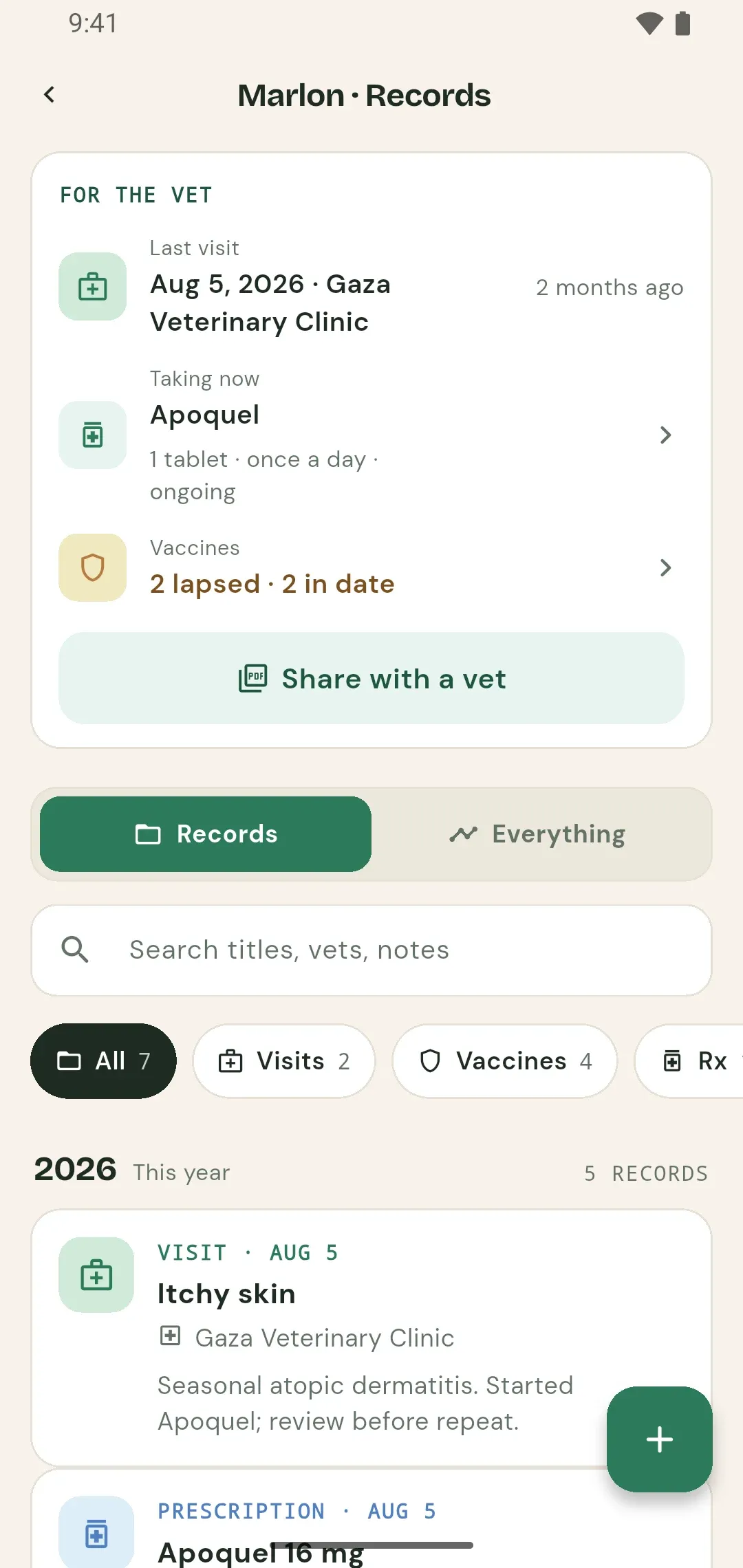
The real difficulty isn’t knowing what to keep; it is keeping it up to date across vets, years and family members. PetTrackr keeps every vaccine with its next due date, vet visits, medicines, lab results and scanned documents like certificates in one place, with a “For the vet” summary and a free PDF export of the health summary to share with any practice.
Sharing records with a sitter or family
If someone else looks after your pet while you are away, leave them the essentials: vet and emergency clinic contacts, the medicine list, allergies, insurance details and a note giving them permission to authorise treatment. Our pet sitter checklist covers the rest.
PetTrackr helps you keep track. It is not veterinary advice: if your pet seems unwell, call your vet.
 How much exercise does a dog need?
 How often to bathe a dog
 How often to clean a litter box