
Adult cat vaccination schedule
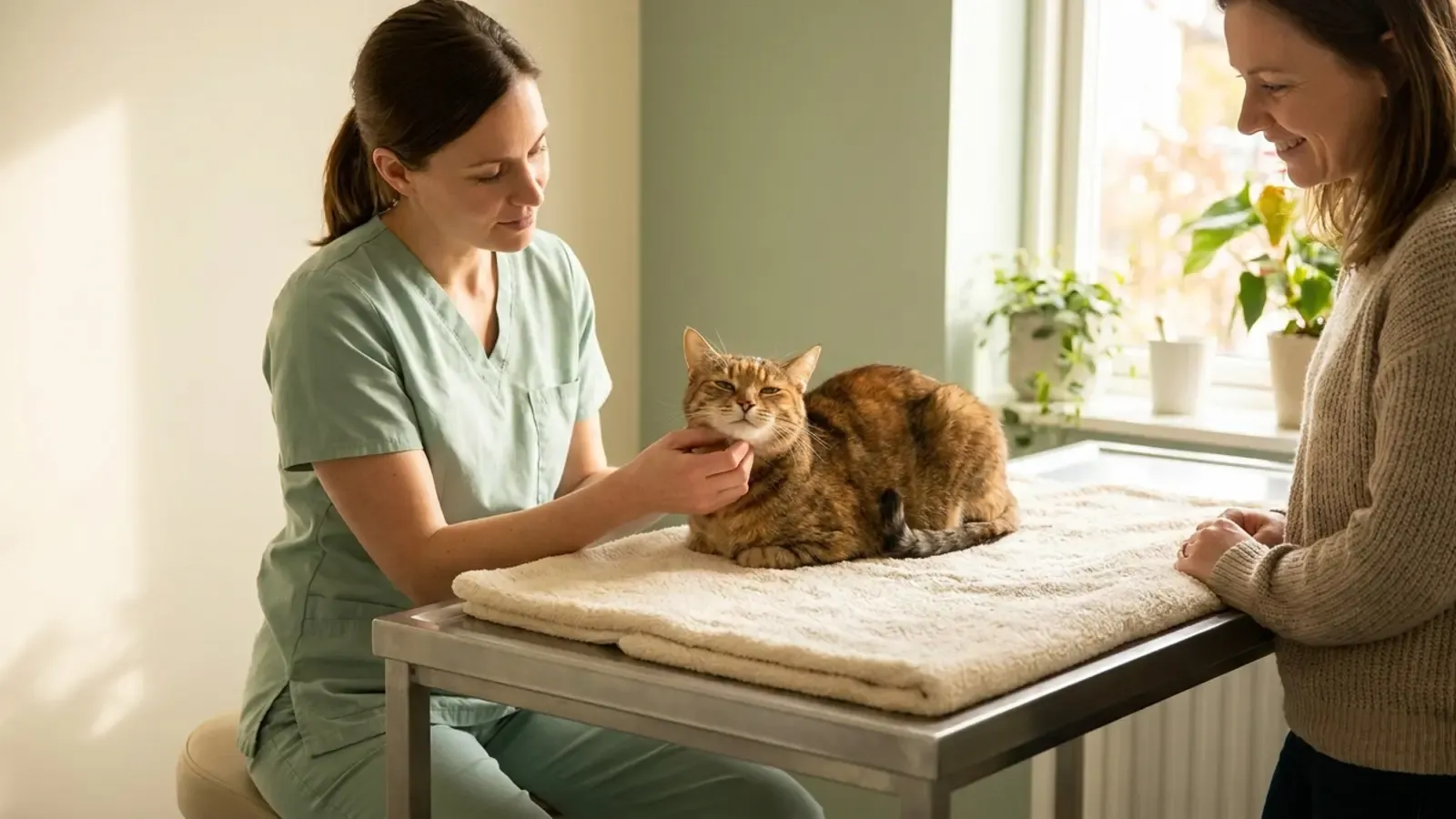
After the kitten shots and a booster at 6 months or 1 year, most adult cats need the FVRCP core vaccine every 3 years. Cats that board or mix with many other cats may get the cat flu part (herpesvirus and calicivirus) every year. Rabies is every 1 or 3 years, depending on the vaccine and local law, and FeLV boosters every 1 to 3 years are only for cats at risk of meeting infected cats.
Cat vaccines are more personal than dog vaccines: the same guidelines give different answers for a single indoor cat and a cat that roams or boards. Here is how to work out which one yours is.
The adult cat booster schedule at a glance
| Vaccine | Type | After the kitten series | Then |
|---|---|---|---|
| FVRCP (panleukopenia, herpesvirus, calicivirus) | Core | Booster at 6 months, or at 1 year | Every 3 years for low-risk cats |
| Cat flu part (herpesvirus, calicivirus) for higher-risk cats | Core | As above | Up to once a year, ideally 1 to 2 weeks before boarding |
| Rabies | Core where rabies is present, often legally required | 1 year after the first dose | Every 1 or 3 years, by vaccine licence and local law |
| FeLV (feline leukaemia virus) | Core for kittens, by risk for adults | 1 year after the starting two doses | Every year if regular exposure is likely, every 2 to 3 years if less likely, or stop if no risk |
These follow the World Small Animal Veterinary Association (WSAVA) 2024 guidelines and the AAHA/AAFP feline guidelines. Your vet will tailor them to your cat and your area.
FVRCP: the core vaccine for every cat
FVRCP (sometimes called the “three-in-one” or “cat flu and enteritis” vaccine) protects against:
- Feline panleukopenia (feline parvovirus or feline enteritis): a severe, often fatal virus that attacks the gut and immune system
- Feline herpesvirus: one of the two main causes of cat flu, with sneezing, runny eyes and sore eyes
- Feline calicivirus: the other main cause of cat flu, often with mouth ulcers
These are core for every cat, indoor or not.
Why the schedule depends on lifestyle
The three parts of the vaccine don’t last equally well:
- Panleukopenia protection from modern vaccines is strong and lasts many years.
- Herpesvirus and calicivirus protection is only partial. Vaccinated cats can still catch cat flu, though usually more mildly, and stress, such as a stay in a cattery, can weaken it.
So WSAVA splits cats into two groups:
- Low-risk cats, such as a single indoor cat that never boards: boosters every 3 years or longer.
- Higher-risk cats, such as cats that board regularly, go to shows, or share a home with cats that come and go: the herpesvirus and calicivirus part up to once a year. If your cat goes to a cattery every year, a booster 1 to 2 weeks before the stay is a good time.
In some countries a two-part cat flu vaccine is available, so a higher-risk cat can get the flu part yearly and panleukopenia every 3 years. Where it isn’t, the full FVRCP may be given yearly. Not sure which group your cat is in? Our guide on whether indoor cats need vaccines goes through it.
Rabies for cats: every 1 or 3 years
In places where rabies is present, WSAVA recommends rabies vaccination for every cat, even where no law requires it. In the US, more cats than dogs are reported with rabies each year, mostly from contact with wildlife, and many states require cats to be vaccinated.
Cat rabies vaccines are licensed for 1 year or 3 years. After the kitten dose and the one-year booster, your cat follows whichever interval the vaccine and local law require. In the UK and other rabies-free countries, cats only need it to travel.
FeLV: by risk after the first year
Feline leukaemia virus spreads between cats through close contact, mutual grooming, shared bowls and bites. It weakens the immune system and can cause anaemia and cancers.
- Kittens: every kitten should be vaccinated, because their lifestyle as adults is not yet known and young cats are the most vulnerable. That is two doses 3 to 4 weeks apart, then a booster a year later.
- Adults: after that, it depends on your cat. AAHA/AAFP suggest a yearly booster if regular contact with FeLV-positive cats, or cats of unknown status, is likely, and every 2 to 3 years if it is less likely. WSAVA calls it core for adult cats with outdoor access, or living with cats that go outdoors, wherever FeLV is common.
- A single indoor-only cat with no contact with other cats usually doesn’t need adult FeLV boosters.
Only FeLV-negative cats should be vaccinated, so a cat of unknown status is tested first.
An adult cat with an unknown history
For a rescued or rehomed adult cat with no records, WSAVA recommends:
- Two doses of FVRCP, 2 to 4 weeks apart
- One dose of rabies, where rabies is present or the law requires it
- FeLV, if the cat is under a year old, goes outdoors or lives with outdoor cats: a negative FeLV test, then two doses 3 to 4 weeks apart
Then your cat joins the adult schedule above.
Other vaccines you might hear about
- Chlamydia felis: a non-core vaccine that may help in multi-cat homes where this eye infection has been a problem.
- Bordetella: a non-core respiratory vaccine for some cats in group housing.
- FIP (feline infectious peritonitis): WSAVA lists the FIP vaccine as not recommended, because there isn’t enough evidence that it works.
Side effects and the lump rule
Most cats have no reaction. When there is one, it is usually mild: a sore spot, tiredness or a smaller appetite for a day or so. Allergic reactions such as facial swelling, vomiting or trouble breathing are uncommon but need a vet straight away.
Very rarely, cats develop a tumour at an injection site, called a feline injection-site sarcoma. Cornell’s Feline Health Center notes that it is uncommon but possible with any feline vaccine. That is why many vets now inject vaccines low on a leg (or in the tail), where any problem is easier to spot and treat, and why WSAVA backs the 3-2-1 rule. Ask your vet to check a lump at a vaccine site if it:
- 3: is still there 3 months after the injection
- 2: is bigger than 2 cm across at any time
- 1: is still growing 1 month after the injection
The benefits of the core vaccines are far greater than this risk, but it is a good reason not to give vaccines more often than your cat needs.
Keeping track
With FVRCP every three years, rabies every one or three, and FeLV on its own timetable, adult cat boosters rarely line up. Ask your vet for the date each one is next due. PetTrackr keeps every vaccine with its own next due date and reminds you before it lapses. For older cats, our senior cat care guide covers what changes at check-ups after about 10 years.
PetTrackr helps you keep track. It is not veterinary advice: if your pet seems unwell, call your vet.
 Deworming schedule for puppies and kittens