
How often to clean a litter box
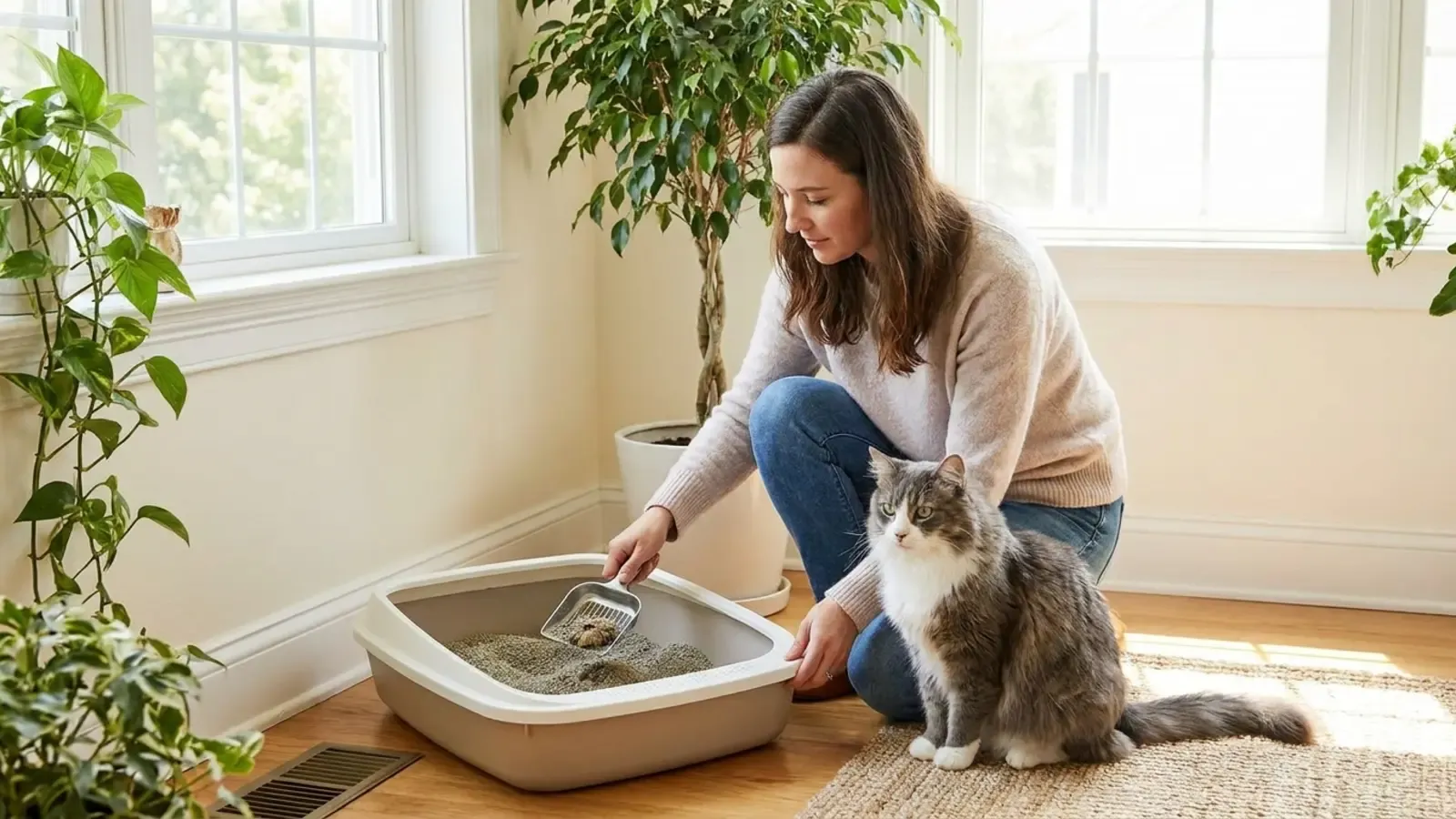
Scoop the litter box at least once a day, removing every clump and poo, and twice a day if you can. For clumping litter, empty the whole box, wash it and refill with fresh litter about once a week. Non-clumping litter soaks up urine rather than forming clumps, so it needs a complete change every couple of days. If you can smell the box, it needs cleaning sooner.
Cats are fastidious. A box that seems fine to you can smell strongly to a cat, and a dirty box is one of the most common reasons cats start going elsewhere.
The cleaning schedule
| Task | How often | How |
|---|---|---|
| Scoop | At least daily, ideally twice | Remove all clumps and faeces; top up with fresh litter |
| Top up | When you scoop | Keep litter at a steady depth of about 3–5 cm (1–2 inches) |
| Full change, clumping litter | About weekly | Empty everything, wash the box, dry, refill |
| Full change, non-clumping litter | Every 2–3 days | Empty, wash, dry, refill |
| Full change, more cats per box | More often | Use smell and appearance as your guide |
| Replace the box | When scratched, cracked or smelly even after washing | Plastic scratches trap odour over time |
Cornell Feline Health Center sums it up: litter should be changed often enough that it looks and smells dry and clean. The AAHA/AAFP Feline Life Stage Guidelines say boxes should be scooped daily and cleaned and replaced regularly, and a cat behaviour counsellor writing for Cats Protection recommends scooping clumping litter at least twice daily and replacing it completely once a week.
Does the type of litter change things?
- Clumping clay or plant-based litter. Urine forms solid clumps you can scoop out, which keeps the rest clean for longer. This is the easiest to keep fresh, and the guidelines note that most adult cats prefer clumping litter.
- Non-clumping clay. Urine soaks in and stays, so scooping removes only the poo. It needs changing far more often.
- Pellets (wood, paper, recycled). Usually used in a box with a sieve or a regular full change. Follow the instructions and change once the pellets have broken down to sawdust.
- Silica crystals. Absorb urine and odour and are changed less often; follow the pack’s instructions. Poo still needs scooping every day.
Whatever you use, check the depth. Too shallow and urine pools on the bottom; too deep and some cats dislike the shifting surface. Cornell says most cats prefer about 1 to 2 inches (3 to 5 cm) of unscented, fine-textured litter.
How to do a full clean
- Empty the box into a bag and put it in the bin. Don’t flush cat litter or faeces unless the product says so, and check local rules.
- Wash the box with hot water and a mild, unscented washing-up liquid or detergent. Scrub the corners and the sides, where urine dries on.
- Rinse thoroughly so no soap smell is left.
- Dry completely before refilling. Damp litter clumps to the bottom.
- Refill with fresh litter to the usual depth.
- Wash the scoop too, and the mat if there is one.
If your vet recommends a stronger disinfectant, for example after an infection, use exactly what they suggest and rinse it off well.
What to avoid
- Phenol-based disinfectants. The Cats Protection article warns that these are toxic to cats. Many traditional household disinfectants contain phenols; a common clue is that they turn cloudy in water. Check the label.
- Ammonia and vinegar. Cornell advises against them because they smell like urine to a cat, which can invite them to go in the wrong place.
- Strongly scented cleaners, sprays and litter deodorisers. A perfume that smells fresh to us can put a cat off the box entirely. Most cats prefer plain, unscented litter.
- Bleach and other harsh chemicals. Even small traces can irritate a cat’s nose and paws, and some are toxic.
- Plastic liners. They often tear, can trap urine, and some cats dislike catching their claws in them.
How many litter boxes do you need?
The usual rule is one box per cat, plus one extra, recommended by Cornell and the AAHA/AAFP guidelines.
| Number of cats | Litter boxes |
|---|---|
| 1 | 2 |
| 2 | 3 |
| 3 | 4 |
| 4 | 5 |
Even one cat benefits from two boxes: many cats prefer to pee in one place and poo in another. Put the boxes in different places, not side by side: two boxes next to each other count as one big box to a cat, and in a multi-cat home one cat can guard a single spot and stop another from using it.
Size, style and location
- Big enough. The AAHA/AAFP guidelines recommend a box at least one and a half times your cat’s length from nose to tail. Most boxes sold are too small; a large plastic storage box often works better.
- Usually uncovered. Cornell notes that most cats prefer an open box that lets smells escape and lets them see around them. Covered boxes hold odour in, which is a reason to scoop them even more often.
- Low sides for kittens and older cats. Stiff joints make a high step painful; see senior cat care.
- Quiet, private and away from food and water. Avoid busy hallways, next to a noisy washing machine, or right by the cat flap or a big window where neighbourhood cats can be seen.
- Easy to reach. For older cats, put a box on every floor they use.
Signs your cat dislikes the litter box
Cats tell you about a box problem long before they give up on it altogether. Watch for:
- Perching on the edge of the box to avoid touching the litter
- Not covering urine or faeces
- Going right next to the box, rather than in it
- Peeing or pooing on other surfaces, such as rugs, bath mats, beds or laundry
- Hesitating or sniffing for a long time before getting in, or rushing in and out
If you see these, first make sure the box is clean, large enough and in a calm place, and that you have enough boxes. Change one thing at a time. If you switch litter, offer the new type in a second box next to the old one so your cat can choose.
When it isn’t the box
A change in litter habits can be a sign of illness. Cornell lists urinary tract inflammation, kidney disease, thyroid disease and diabetes, as well as digestive problems, arthritis and age-related confusion, among medical causes. Book a vet visit if your cat is:
- Going to the box much more often, or producing more urine than usual (big clumps)
- Peeing small amounts often, or there is blood in the urine
- Straining, crying or licking their genitals a lot
- Having diarrhoea or constipation
If your cat, especially a male cat, is straining in the box and passing little or no urine, call a vet or emergency clinic immediately. A blocked bladder can become life-threatening within hours.
Our guide to a cat peeing outside the litter box goes through the causes and fixes in more detail.
Litter and your health
Cat faeces can carry the parasite that causes toxoplasmosis. The CDC advises changing the litter box daily, since the parasite doesn’t become infectious straight away, and washing your hands afterwards. If you are pregnant or have a weakened immune system, ask someone else to do it where possible, and talk to your doctor about extra precautions.
Making it a habit
The daily scoop is easy to skip on a busy day, and the weekly full change is easy to forget altogether, especially when more than one person in the house shares the job. PetTrackr puts the scoop and the full change on your cat’s daily plan with reminders, and the cat’s Bathroom screen shows when the box was last scooped and changed, so everyone can see at a glance whose turn it is.
PetTrackr helps you keep track. It is not veterinary advice: if your pet seems unwell, call your vet.
 How to introduce a new cat
 How to trim cat nails
 Pet medical records to keep