
Adult dog vaccination schedule

Once the puppy shots are done, most adult dogs need the DHPP core vaccine every 3 years, rabies every 1 or 3 years (depending on the vaccine and local law), and leptospirosis every year. Lifestyle vaccines such as kennel cough, Lyme disease and canine flu are usually given yearly, and only to dogs whose life puts them at risk.
That is the short version. Here is the full adult dog booster schedule, why each vaccine runs on its own timetable, and what to do with a dog whose history you don’t know.
The adult dog booster schedule at a glance
| Vaccine | Type | First booster after the puppy series | Then |
|---|---|---|---|
| DHPP (distemper, adenovirus, parvovirus, ± parainfluenza) | Core | At 6 months, or within a year | Every 3 years, not more often |
| Rabies | Core where rabies exists, often legally required | 1 year after the first dose | Every 1 or 3 years, by vaccine label and local law |
| Leptospirosis | Core in many regions | 1 year after the starting two doses | Every year |
| Kennel cough (Bordetella, parainfluenza) | Lifestyle | 1 year | Usually yearly |
| Lyme disease | Lifestyle, tick areas | 1 year after the starting two doses | Every year |
| Canine influenza | Lifestyle, where outbreaks occur | 1 year after the starting two doses | Every year |
Your vet will adjust this to where you live, what your dog does and the products they use. Treat the table as the shape of the plan, not a prescription.
Core vaccines: every adult dog
DHPP: every 3 years
DHPP (also written DA2PP or DAPP) protects against distemper, adenovirus (canine hepatitis) and parvovirus, often with parainfluenza in the same shot. These are the diseases that kill unprotected dogs, and the vaccines for them are some of the best in veterinary medicine.
The World Small Animal Veterinary Association (WSAVA) says modern core vaccines give immunity that lasts many years, and that once a dog has responded to the puppy series, boosters should be given no more often than every 3 years. The American Animal Hospital Association (AAHA) recommends the same 3-year rhythm after the first adult booster.
Two details people often miss:
- The 6-month or 1-year booster matters. It catches the few puppies whose mother’s antibodies blocked the last puppy shot. WSAVA now suggests giving it at 26 weeks rather than waiting until a year.
- Old age is not a reason to stop. WSAVA is clear that there is no age at which it becomes safe to stop vaccinating a dog. Seniors keep the same every-3-years core schedule. See our senior dog care guide for what else changes as dogs age.
Rabies: every 1 or 3 years
Rabies vaccines come with a licensed duration of 1 year or 3 years. The first adult booster is given about a year after the puppy dose, and after that your dog follows whichever interval the vaccine label and local law require. Where the law and the label disagree, the law wins.
If you are in the US, rabies vaccination is required for dogs in most states. In the UK, rabies is not present, so dogs are only vaccinated if they are travelling abroad. Our rabies vaccine guide covers 1-year versus 3-year shots, travel rules and side effects.
Leptospirosis: every year
Leptospirosis is a bacterial disease spread in the urine of rats and wildlife, often through puddles, ponds and wet grass. It can cause kidney and liver failure, and it can pass to people.
In 2024, both WSAVA and AAHA moved it up: WSAVA calls it core wherever the disease is common and suitable vaccines exist, and AAHA now recommends it as core for all dogs. Protection is shorter-lived than for viral vaccines, so it needs a booster every year. A dog starting from scratch needs two doses, 2 to 4 weeks apart.
Lifestyle vaccines: depending on your dog’s life
These are recommended for some dogs and not others. Most last about a year, which is why WSAVA describes an adult dog as possibly being vaccinated every year, with different components each year.
- Kennel cough (Bordetella and parainfluenza): for dogs that board, go to daycare, groomers, shows or training classes. It comes as a nose drop, a mouth drop or an injection. It reduces how ill a dog gets rather than preventing every infection. Some boarding kennels set their own rules on how recent it must be, so check before you book.
- Lyme disease: for dogs in areas with ticks that carry it, alongside year-round tick prevention. See our guide to flea and tick prevention for dogs.
- Canine influenza: where outbreaks occur, for social dogs.
Killed (inactivated) vaccines like Lyme and flu start with two doses 2 to 4 weeks apart, then a yearly booster.
An adult dog with an unknown history
Rescue and rehomed dogs often arrive with no records. The good news is that catching up is simpler than a puppy series. According to WSAVA:
- One dose of DHPP (a modified-live core vaccine) is very likely to protect a dog over 26 weeks old for the long term. In a high-risk situation, such as an outbreak, a second dose 2 to 4 weeks later is sensible.
- One dose of rabies immunises, followed by boosters as local law requires.
- Leptospirosis needs two doses, 2 to 4 weeks apart, then yearly.
After that, the dog joins the normal adult schedule above.
Titer testing instead of a booster
A titer test is a blood test that measures antibodies. For distemper, adenovirus and parvovirus, a good result shows your dog is still protected, and WSAVA supports using titers to fine-tune core booster intervals in adult dogs. They are not a substitute for rabies vaccination where the law requires it, and they don’t tell you anything useful about leptospirosis or kennel cough, which still need their own boosters.
The yearly check-up still matters
Because different vaccines fall due in different years, it is easy to think a year with “no shots” means no visit. WSAVA encourages vets to talk about an annual health check rather than a “vaccine appointment”: weight, teeth, heart, joints and lumps all change faster than vaccine schedules. Your vet will usually also talk about heartworm and parasite prevention at the same visit; see heartworm prevention for dogs.
Keeping track of three different clocks
The tricky part of adult vaccines is that they don’t line up: leptospirosis every year, rabies on a 1- or 3-year cycle, DHPP every third year. Ask your vet for the date each one is next due, and keep the certificate where you can find it when a kennel or groomer asks. PetTrackr keeps each vaccine with its own next due date and reminds you before it lapses.
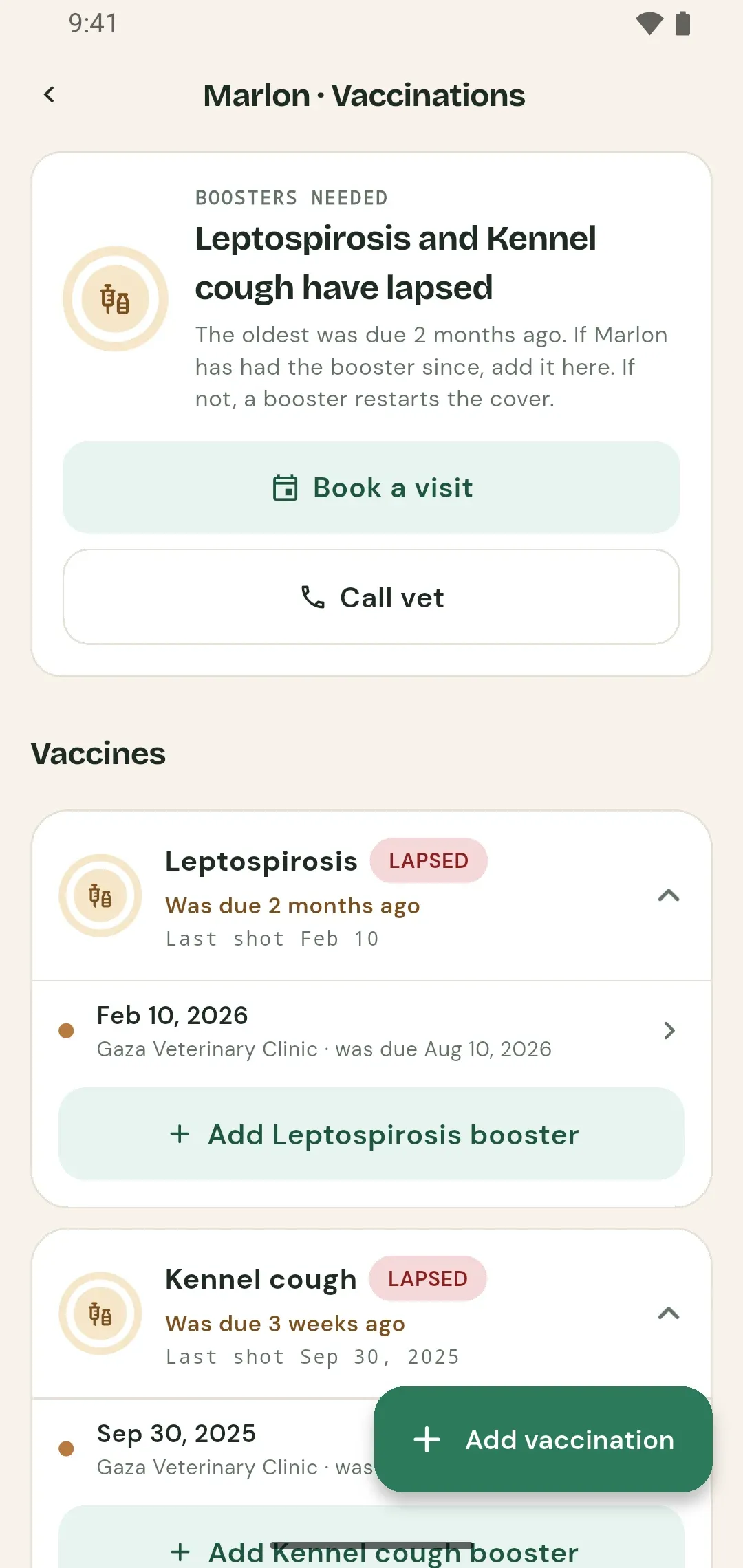
If a date has already slipped past, don’t worry: in most cases it is a single catch-up visit. Our guide on what to do if your dog missed a booster explains what happens next.
PetTrackr helps you keep track. It is not veterinary advice: if your pet seems unwell, call your vet.
 Deworming schedule for puppies and kittens
 Flea and tick prevention for dogs
 Heartworm prevention for dogs