
Separation anxiety in dogs
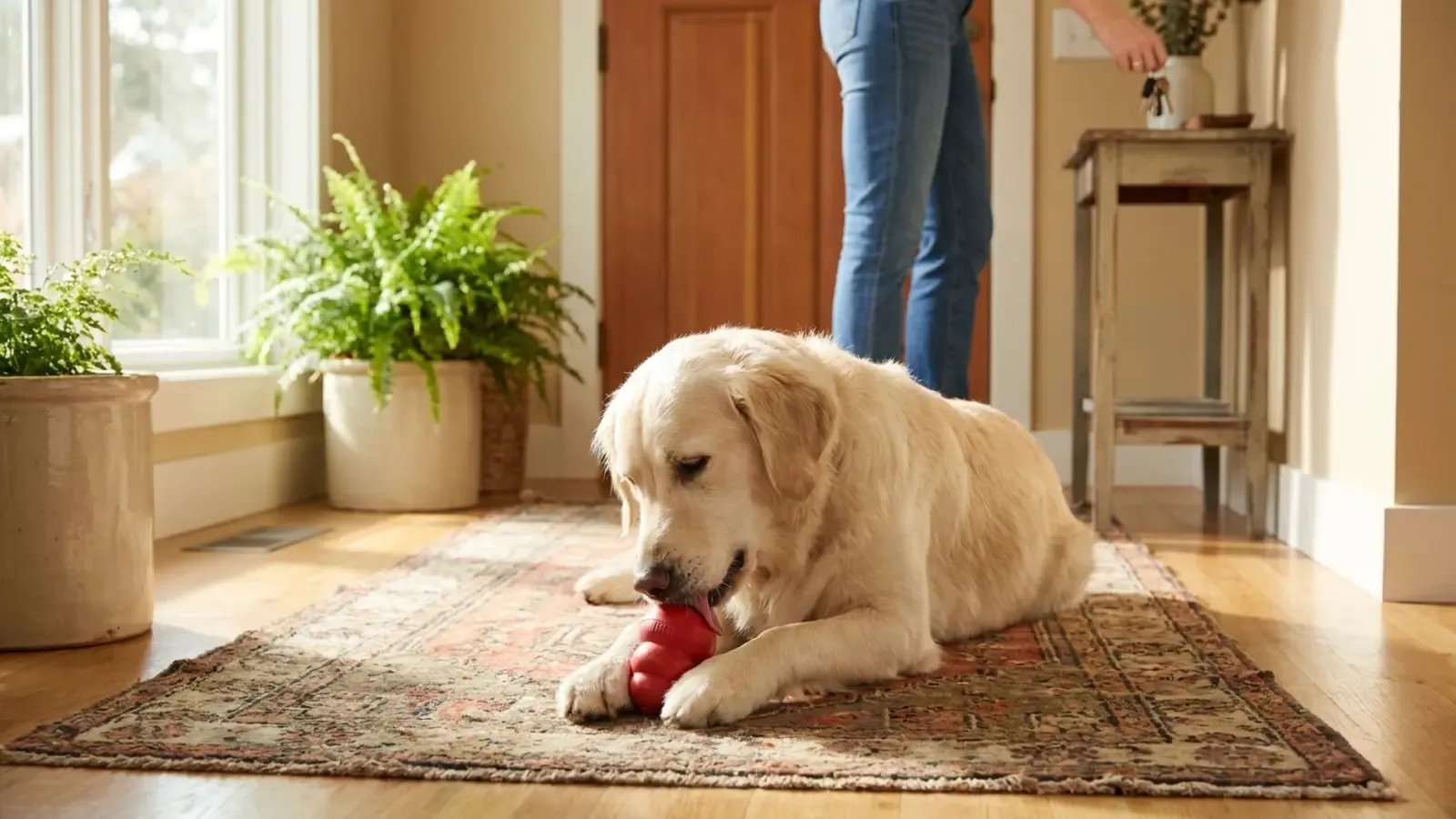
Separation anxiety is real distress, not naughtiness or spite: a dog who panics when left alone barks or howls, chews at doors, toilets indoors, drools or paces, usually within minutes of you leaving. The fix is to teach your dog, in tiny steps, that being alone is safe, while avoiding leaving them for longer than they can cope with. If it is more than mild, get help from your vet and a qualified behaviourist early, because it rarely goes away on its own.
Signs of separation anxiety
The signs happen when your dog is alone, or separated from a particular person. The Merck Veterinary Manual and Dogs Trust list:
- Vocalising: barking, whining or howling
- Destruction aimed at exits: chewing or scratching doors, door frames and windows, or your belongings
- Toileting indoors in a dog who is otherwise house trained
- Drooling, panting and trembling
- Pacing, restlessness, not settling
- Not eating food or chews left for them
- Trying to escape, sometimes hurting themselves
Many dogs start to worry as you get ready to go: picking up keys, putting on shoes, reaching for a coat. Some follow you from room to room, or greet you very intensely when you come back.
The best way to know: film it
The AVSAB calls video the most effective and accurate way to tell. Set up a camera or a phone and record at least the first 30 to 60 minutes after you leave. Dogs with separation anxiety usually show distress early, many within the first 10 minutes. Watch for subtle signs too: lip licking, panting, restlessness, whining.
What else it could be
Several problems look like separation anxiety, and they need different answers:
| Looks like separation anxiety | What to check |
|---|---|
| Toileting indoors | Incomplete house training, a urinary or gut problem, or being left longer than they can hold on |
| Chewing and destruction | Boredom, teething in a young dog, or not enough exercise and things to do |
| Barking when alone | Reacting to noises or people passing outside, rather than to your absence |
| Sudden change in an older dog | Pain, illness or age-related changes |
| Panic during storms or fireworks | A noise phobia, which can happen whether you are home or not |
Dogs Trust advises seeing your vet if behaviour changes suddenly or your dog starts seeking reassurance more than usual, because medical problems can cause or worsen anxiety.
What causes it
Dogs Trust says the most common cause is simply that a dog has never learned that being alone is okay. Other things that can play a part:
- A change in routine, such as returning to the office after a long stretch at home
- A house move, a new baby, or the loss of a person or another pet
- Genetics and early experiences, including being separated from the mother too young
- A frightening event while alone
It is not a sign that your dog is spoilt, and it is not their fault.
How to help: teaching your dog to be alone
The principle is simple: build up time alone so gradually that your dog stays relaxed at every step. Done well it can take weeks or months, because each step must be easy.
1. Stop the panic happening
Every time your dog panics, the fear grows. The AVSAB notes most dogs get worse without treatment. While you work on it, try not to leave your dog for longer than they can cope with. Options include a friend or relative, a dog sitter (our pet sitter checklist covers what to leave them), doggy daycare (if your dog enjoys it), or taking them with you.
2. Teach settling while you are home
Teach your dog to relax on a mat or bed with a long-lasting chew or a food puzzle. Then, over many sessions, the AVSAB suggests gradually:
- Moving a little further away
- Staying away a little longer
- Moving out of sight briefly, then coming back
Change only one thing at a time: distance or duration, never both at once.
3. Make departure cues boring
If picking up your keys sends your dog into a spin, pick them up and sit down. Put your coat on and make a cup of tea. Do these things at random until they no longer predict you leaving.
4. Practise very short absences
Once your dog is relaxed with you out of sight inside the house, start real departures:
- Step outside and close the door for a second or two. Come back in calmly.
- Repeat, building up a few seconds at a time over many sessions.
- Use your camera to check your dog stays settled.
- If they show stress, the ASPCA advises shortening the absence to a point where they can relax, then progressing more slowly.
Some people use a “safety cue”, such as a particular blanket or radio station, only during practice absences that are short enough to succeed. Dogs Trust describes a similar “I’m busy” signal.
Keeping track of how long your dog managed last time is what stops you pushing too fast. PetTrackr’s Alone without distress course builds the time up in small steps, starts each session from your dog’s last calm stay, and ends the session the moment they get upset.
5. Keep comings and goings low key
Leave and return calmly, without big goodbyes or excited greetings. A good walk or play session beforehand, and a food puzzle as you go, help many dogs settle. The AVSAB suggests exercising your dog at least 30 minutes before leaving; see how much exercise a dog needs for your dog’s breed and age.
What not to do
- Don’t punish your dog for anything you find when you get home. The AVSAB is clear that these are symptoms of distress, and punishment makes the anxiety worse.
- Don’t rely on a crate. Dogs Trust warns that crate training alone won’t stop a dog worrying, and a panicking dog can injure itself in one.
- Don’t rush into a second dog as a fix. Resolve the anxiety first.
- Don’t push through stress. If a step is too hard, go back to an easier one.
When to see your vet or a behaviourist
Get professional help if:
- Your dog injures themselves, damages doors or windows trying to escape, or seems to be panicking
- Signs started suddenly, or your dog is older or unwell in any other way
- You have tried gradual training for a few weeks and things aren’t improving
- You can’t avoid leaving your dog for long stretches
Start with your vet, who can check for medical causes and refer you to a veterinary behaviourist or a qualified, reward-based clinical animal behaviourist. Some dogs improve faster with medication prescribed alongside a behaviour plan, as VCA notes; only a vet can decide whether that is right for your dog, and which medicine and dose. Never give your dog human anti-anxiety or sleeping medication.
With the right plan, most dogs with separation anxiety can learn to cope much better. Patience, and small steps, are what make it work.
PetTrackr helps you keep track. It is not veterinary advice: if your pet seems unwell, call your vet.
 How to stop a dog pulling on the lead
 How to stop a puppy biting
 Why do dogs eat poop?