
Sharing pet care with family
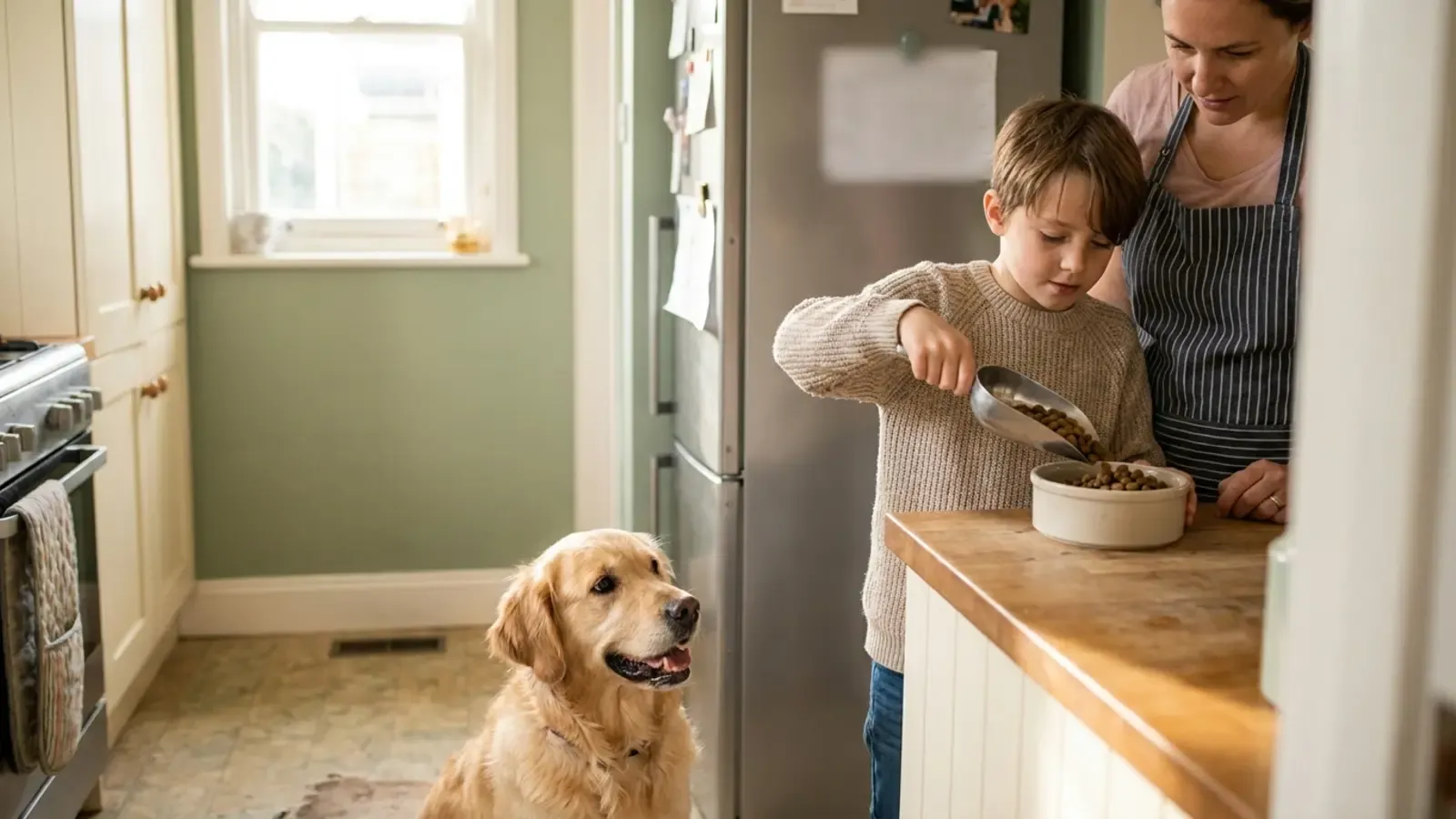
The way to share pet care without things falling through the gaps is simple: list every job, give each one a single named owner and a backup, and keep one shared record that everyone ticks the moment a job is done. That one habit prevents the two classic household mistakes, the pet fed twice and the pet not fed at all, and the much more serious one: a medicine given twice because two people each thought it was their turn.
Why shared care goes wrong
Most pet-care mix-ups in a family aren’t about anyone being careless. They happen because:
- Nobody owns the job. “We all feed the dog” often means nobody is sure whether the dog has been fed.
- Everyone owns the job. The cat gets breakfast from you at 7 and from your partner at 7.30.
- Plans change and nobody says. Someone works late, and the evening walk quietly doesn’t happen.
- The record is in someone’s head. You know you gave the tablet; your teenager doesn’t.
A chore chart fixes most of this, as long as it is used at the moment a job is done, not filled in from memory at night.
Step 1: List every job
Start by writing down everything your pet needs, with how often and roughly when. Most households underestimate the list.
| Job | How often | Typical time |
|---|---|---|
| Breakfast | Daily | Morning |
| Dinner | Daily | Evening |
| Fresh water, wash bowls | Daily | Morning |
| Morning walk / toilet trip (dog) | Daily | Morning |
| Evening walk (dog) | Daily | Evening |
| Scoop litter (cat) | Daily, ideally more (how often) | Morning and evening |
| Full litter change (cat) | Weekly or as needed | Weekend |
| Medicine or supplements | As prescribed | Set times |
| Brushing | A few times a week | Any |
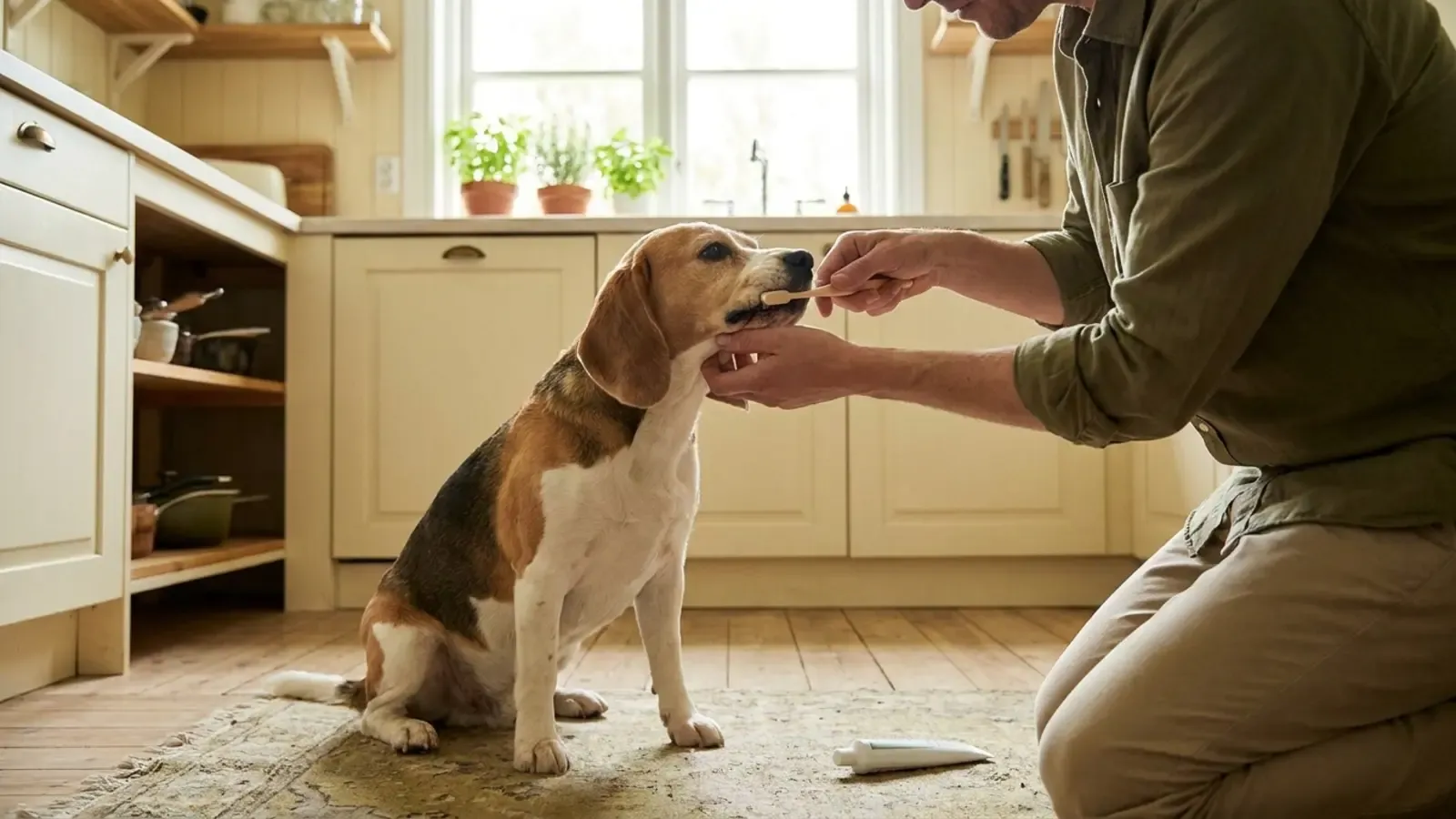
| Teeth brushing | Daily if possible | Evening |
| Play and training | Daily | Any |
| Flea, tick and worming treatment | Monthly or as advised | Set date |
| Nail trims, baths | Every few weeks | Weekend |
| Vet appointments and boosters | As due | Booked |
| Buying food and supplies | Before running out | Any |
Step 2: Give every job one owner and a backup
For each job, write one name next to it. Then write a backup: the person who covers it if the owner can’t.
Some families split by time of day (one person does all mornings, another all evenings). Others split by job (one person feeds, another walks). Splitting by time of day often works better, because it is obvious who is “on” at any moment.
A simple weekly chore chart
Copy this onto paper for the fridge, or into a shared note.
| Mon | Tue | Wed | Thu | Fri | Sat | Sun | |
|---|---|---|---|---|---|---|---|
| Breakfast | Sam | Sam | Sam | Sam | Sam | Alex | Alex |
| Morning walk | Alex | Alex | Alex | Alex | Alex | Mia | Mia |
| Water and bowls | Mia | Mia | Mia | Mia | Mia | Mia | Mia |
| Evening walk | Sam | Alex | Sam | Alex | Sam | All | All |
| Dinner | Alex | Alex | Alex | Alex | Alex | Sam | Sam |
| Medicine (8am / 8pm) | Sam | Sam | Sam | Sam | Sam | Sam | Sam |
| Backup for everything | Alex | Sam | Alex | Sam | Alex | Sam | Alex |
Leave space to tick each box with the time it was done.
Step 3: Keep one record, and tick it straight away
The chart only works if it reflects what actually happened:
- Tick immediately, with the time, not later.
- Check before you do. Before feeding or giving medicine, look at the chart. If it’s ticked, it’s done.
- One record only. A chart on the fridge and a family group chat will disagree within a week.
- Measure the day’s food in advance if double feeding is a worry: put the day’s portion in a container, and meals come out of it. When it’s empty, the pet has eaten.
Medicine needs the strictest system
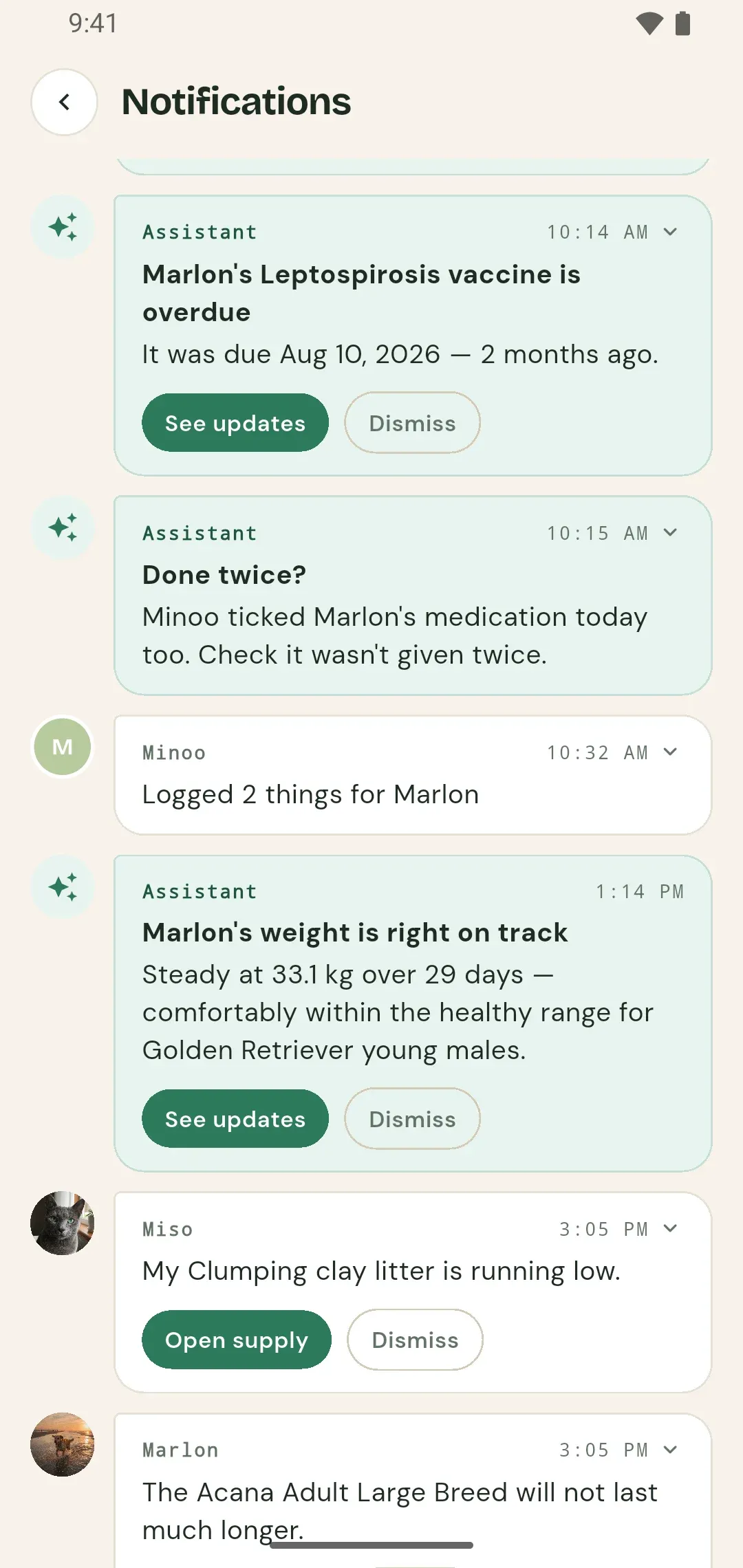
Two people giving the same dose is the mix-up that can actually harm a pet. Depending on the drug, a double dose can range from harmless to serious.
- One person owns each medicine. Others only give it if the owner asks them to.
- Write down every dose with the time, straight after giving it.
- Keep medicine in one place, out of reach of pets and children, with the instructions. If tablets are a struggle, see how to give a dog a pill.
- Use a pill organiser for daily tablets, so an empty compartment shows a dose was given.
- Never “top up” if you are unsure whether a dose was given. Ask your vet instead.
If you think your pet has been given a double dose, call your vet straight away, or an emergency vet or animal poison helpline if your practice is closed. The FDA suggests having your pet’s weight, the amount given, the time, and the packaging to hand. Don’t give the next dose, and don’t try to make your pet sick, unless a vet tells you to.
This is where a shared app earns its keep. In PetTrackr, each task can be assigned to one person, whose phone reminds them; everyone sees who did what as soon as it’s ticked, and you get a warning if two people mark the same medicine dose as given.
Pet care jobs for kids, by age
Helping with a pet teaches children responsibility and empathy, but an adult always stays responsible for the pet. The American Academy of Pediatrics and the AKC agree that young children should be supervised around pets. Ages are a guide; you know your child and your pet.
| Age | Jobs they can help with |
|---|---|
| 3–5 | Help scoop food into a bowl with an adult, top up water with help, put toys away, gentle stroking while supervised |
| 5–7 | Fill the water bowl, give a treat after a walk, help clip on the lead, help brush, choose a toy for play |
| 8–10 | Measure out meals with a check from an adult, walk the dog alongside an adult (or alone if the dog is calm and easy to hold), help with simple training, scoop litter with gloves and handwashing |
| 11–13 | Feed independently with spot checks, walk a manageable dog alone, help with grooming and training sessions |
| 14+ | Most daily care, including walks; medicine only under clear adult supervision |
A few rules work well:
- Kids don’t give medicine unless a parent is right there.
- Always wash hands after feeding, scooping litter or picking up poop.
- Leave pets alone when eating or sleeping, and never put faces close to a pet’s face, as pediatric guidance advises.
- Check the job was done, kindly. A forgotten water bowl is a lesson, not a crisis, but only if an adult catches it.
Housemates and co-parents
The same system works for flatmates sharing a pet, or for a pet who moves between two homes:
- Agree who is the primary carer for vet decisions and who pays for what.
- Share the vet details, medical history and medication schedule so either home can cope.
- Hand over with a short note: when the pet last ate, walked, had medicine, and anything odd.
- Keep one shared record both homes can see.
Handoffs that don’t drop the ball
Most missed walks and doubled meals happen at handoffs: someone swaps a shift, goes away, or gets home late. Make handoffs explicit:
- Say it out loud, or in the shared record: “I can’t do tonight’s walk, can you?” “Yes, I’ve got it.”
- The job stays yours until someone confirms they’ve taken it.
- Before a trip, run through the week with whoever is covering. If someone outside the family is stepping in, use our pet sitter checklist.
A quick family checklist
- Every job written down, with a time
- One owner and one backup per job
- One shared record, ticked straight away
- Medicine: one owner, every dose written down
- Kids’ jobs suit their age, and an adult checks
- Handoffs are confirmed, not assumed
PetTrackr helps you keep track. It is not veterinary advice: if your pet seems unwell, call your vet.
Sources
- HealthyChildren.org (American Academy of Pediatrics): How old should our children be before we adopt a pet?
- HealthyChildren.org (American Academy of Pediatrics): Age-appropriate chores for children
- US FDA: Medications for your pet, questions for your vet
- American Kennel Club: Raising kids and dogs together
 How often to bathe a dog
 How often to clean a litter box
 How to brush a dog’s teeth