
Why does my cat bite me?

Most cats who bite their owners are playing, have had enough of being stroked, are frightened, or are in pain. Play biting is the most common, especially in young, energetic cats whose hunting instinct has nowhere else to go. Petting-related bites usually come after warning signs like a twitching tail or flattening ears. The fix depends on the reason: more play with toys (never hands), shorter petting sessions that stop before the bite, giving fearful cats space, and a vet check for any cat whose biting is new.
The four main reasons cats bite
| Type | When it happens | Typical signs | What helps |
|---|---|---|---|
| Play | Ambushing ankles, grabbing moving hands, often in young cats | Crouching, stalking, wiggling bottom, pouncing, tail thrashing, wide pupils | Daily play with wand toys, never use hands or feet as toys |
| Petting-induced | After a few minutes of stroking, even when your cat seemed to enjoy it | Tail twitching or thumping, skin rippling, ears back, turning the head to your hand | Short sessions, stop at the first sign |
| Fear | When cornered, picked up, at the vet, around visitors or other animals | Crouching, ears flat, hissing, tail tucked, wide pupils | Space, an escape route, no forcing |
| Pain | When touched or handled, especially in one area | Sudden biting in a usually gentle cat, hiding, less grooming or jumping | A vet check |
There is also redirected aggression: a cat agitated by something they can’t reach, like a cat outside the window, lashes out at whoever is nearest. The ASPCA calls this probably the most dangerous type, because the bites are not held back. Never pick up or comfort a cat who is staring, growling or puffed up at something; give them time to calm down alone.
Play biting
Cats are predators, and play is practice for hunting: stalk, chase, pounce, bite. Kittens learn bite strength from their littermates and mother. A cat who didn’t, or who has lots of energy and too little to do, may treat your feet and hands as prey. The ASPCA notes that this is the most common kind of aggression cats show toward their owners, and that cats who are left alone for long hours, or were encouraged to chase hands as kittens, are more likely to do it.
How to stop play biting:
- Never use hands or feet as toys, even with a tiny kitten. What is cute at 10 weeks hurts at 10 months.
- Play with your cat every day, ideally at least two sessions, using a wand toy that keeps your hands well away from their teeth. Let them stalk, chase and finally “catch” the toy.
- End with a win and a meal. Let them catch the toy at the end, then offer food. Hunt, catch, eat, rest is the natural rhythm.
- Spot the pattern. Cornell suggests noting when and where ambushes happen, and getting ahead of them with play or a toy tossed ahead of you before your cat pounces.
- Offer solo fun for when you are busy: puzzle feeders, kicker toys, window perches, a cat tree.
- Consider a second cat, sometimes. A playful young cat living alone may do well with a playmate of similar age and energy, but only if your current cat is likely to welcome one. See how to introduce a new cat.
Petting-induced biting (“love bites”)
Many cats enjoy a few strokes and then, suddenly, bite. It feels unprovoked, but it rarely is. Being stroked can go from pleasant to irritating, and the bite is your cat’s way of saying “that’s enough.” The ASPCA lists the warning signs that usually come first:
- Tail twitching, flicking or thumping
- Ears turning sideways or flattening
- Skin rippling along the back
- Turning their head towards your hand
- Restlessness, shifting position, or stopping purring
- Dilated pupils
How to prevent it:
- Watch for those signals and stop stroking at the first one. Simply stop, and let your cat stay or leave.
- Keep sessions short. If your cat bites after about two minutes, stop at one.
- Stroke where cats generally like it: cheeks, chin and the top of the head. Many cats dislike belly rubs and long strokes down the back to the tail.
- Let your cat come to you. A cat who chooses the contact is more likely to enjoy it.
- Be gentle around the hips and back, especially in older cats: sudden sensitivity there can be a sign of pain.
Fear biting
A frightened cat would rather run or hide. Biting happens when they feel trapped: picked up against their will, cornered behind the sofa, held for medicine, or approached by a stranger. The ASPCA’s advice for a frightened cat is simply to avoid them until they calm down.
- Always leave your cat an escape route and a place to hide.
- Let visitors ignore a shy cat and let the cat approach in their own time.
- Don’t reach into a hiding spot for a frightened cat.
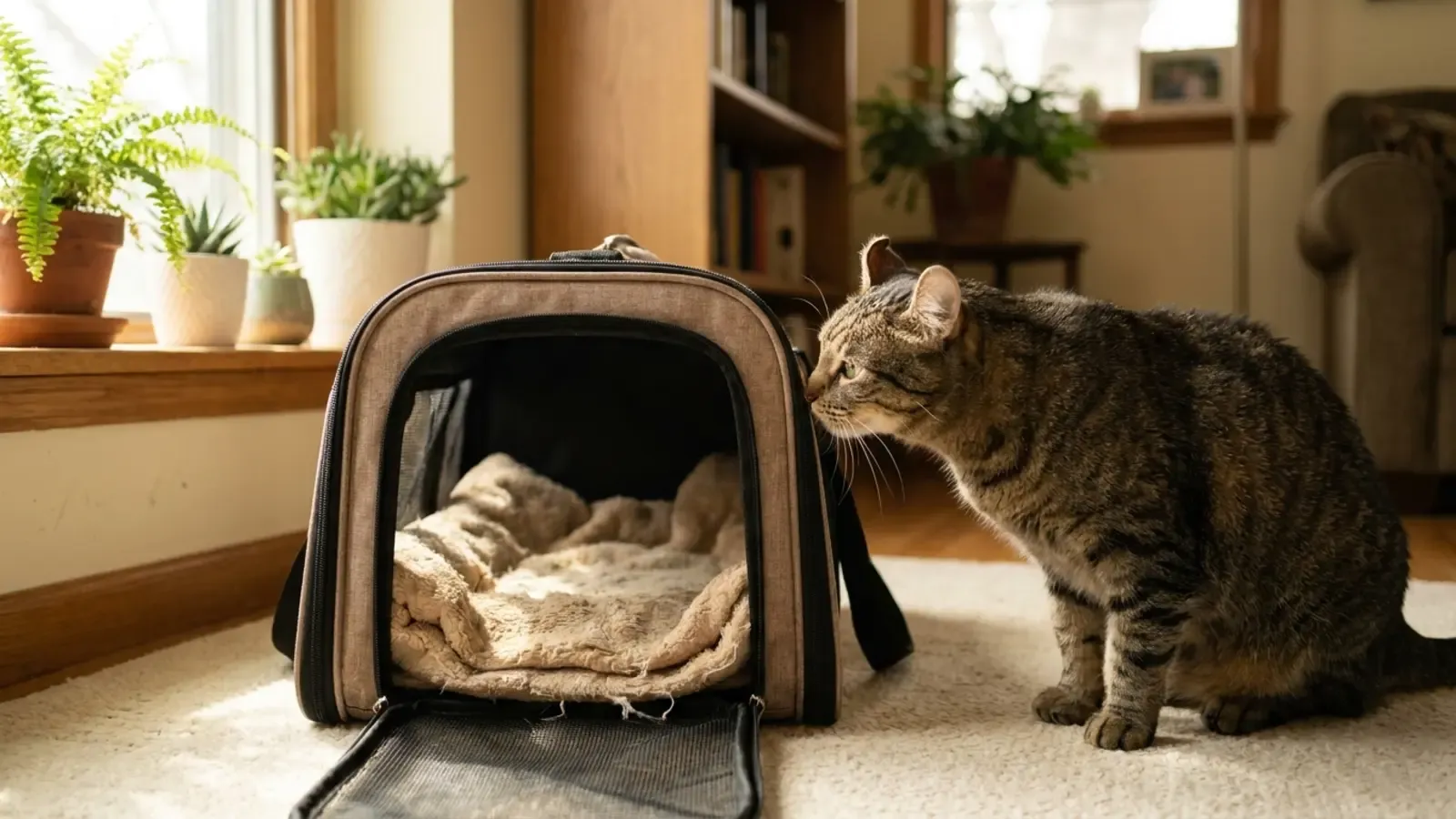
- For handling, vet visits and the carrier, train gently and gradually with treats. Our guide on how to get a cat into a carrier shows the approach.
Pain biting: when to see a vet
A gentle cat who starts biting, especially when touched in one place or picked up, may be hurting. The ASPCA says a medical workup is essential for every aggressive cat, because conditions like arthritis, dental disease, abscesses and hyperthyroidism can cause or worsen it. Cats are experts at hiding pain, so look for other signs too: hiding, sleeping more, grooming less, not jumping up, or changes in appetite or litter box habits. Our guide to signs of pain in cats covers the subtle ones.
See your vet if your cat’s biting is new, sudden, getting worse, or comes with any change in health or behaviour.
What to do in the moment
- Go still. If your cat grabs your hand or foot, stop moving rather than yanking it away. A struggling hand is exciting prey, and pulling can turn a nip into a deep bite.
- Stay calm and quiet. Cornell notes that retreating or showing fear can reinforce the behaviour if your retreat is what the cat wants.
- End the interaction. Calmly withdraw your attention for a few minutes, or offer a toy to bite instead.
- Never punish. Hitting, tapping the nose, spraying water or shouting can make your cat fearful and more likely to bite, and Cornell warns that physical punishment can make aggression worse.
If you are bitten
Cat bites look small but can be deep, and they become infected easily. Wash the bite straight away with soap and plenty of running water, and contact your doctor if the skin is broken, particularly on the hand or near a joint, or if it becomes red, swollen, hot or painful.
When to get extra help
If biting is frequent, causes injuries, involves children, or you can’t work out the trigger, ask your vet for a full check-up first and then a referral to a qualified feline behaviourist or veterinary behaviourist. Most biting improves a great deal once the reason is found.
PetTrackr helps you keep track. It is not veterinary advice: if your pet seems unwell, call your vet.
 How to get a cat into a carrier
 How to stop a cat scratching furniture