
How to get a cat into a carrier
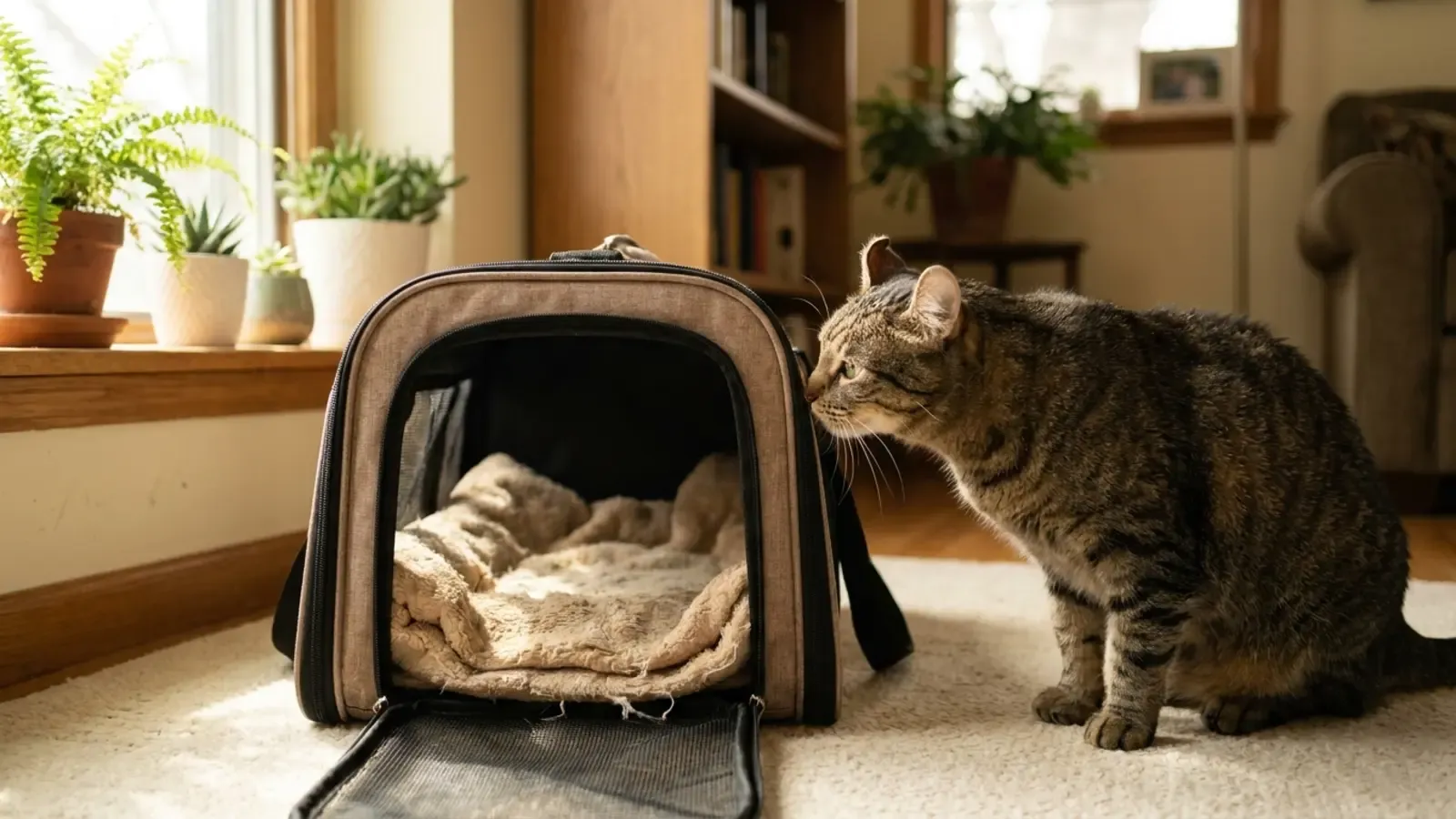
The easiest way to get a cat into a carrier is to make the carrier part of the furniture: leave it out all the time, with a soft bed and the odd treat inside, until your cat chooses to nap in it. If you need to go today, shut your cat in a small room first, keep the carrier out of sight until the last moment, and lower them in gently, back end first, through the top.
Most cats only ever see the carrier on the day it means a car and a vet (often for their yearly check-up and boosters), so of course they vanish. Here is how to change that, and how to manage in the meantime.
Choose a carrier that makes it easy
The carrier itself solves half the problem. International Cat Care recommends:
- Sturdy and wipeable. Cardboard is no match for a determined cat.
- Opens from the top, so you can lift your cat in and out instead of pushing or tipping.
- A top half that comes off, so the vet can examine a nervous cat in the familiar base.
- The right size. Big enough to turn around and lie down, but not so big that your cat slides around inside.
Soft bags suit some calm cats, but a frightened cat can be hard to get in and out of one, and they can collapse.
Carrier training, step by step
Carrier training works by teaching your cat that the carrier is a nice, normal place. Allow time for your cat to be relaxed at each step before moving on. If they tense up, freeze or back away, go back a step.
| Step | What you do | Move on when |
|---|---|---|
| 1. Make it furniture | Leave the carrier out, door off or wedged open, somewhere your cat already likes to rest | Your cat walks past it without a second look |
| 2. Make it smell like home | Put their usual bedding inside. Wipe a soft cloth on their cheeks and rub it on the carrier | Your cat sniffs it calmly |
| 3. Make good things happen there | Drop treats beside it, then just inside, then at the back. Feed meals next to it, then inside | Your cat goes in on their own for food |
| 4. Make it a bed | Keep the blanket inside and keep treats appearing now and then | Your cat chooses to rest in it |
| 5. Close the door | While your cat eats inside, close the door for a second, then open it. Build up slowly | Your cat stays relaxed with the door shut |
| 6. Lift and carry | Lift the carrier an inch, put it down, treat. Then carry it a few steps round the house | Your cat stays calm while being carried |
| 7. Short trips | Sit in the parked car, then a short drive round the block, then home and treats | Short trips don’t upset your cat |
A few things help along the way:
- Synthetic feline pheromone sprays can help some cats. International Cat Care suggests spraying the carrier at least 15 minutes before your cat goes in, so the alcohol carrier has evaporated.
- Never use the carrier to punish or confine your cat for something they dislike at home.
- Let them come out by themselves. Pulling a cat out undoes the work.
Kittens learn this fastest, so if you have a young cat, start now; it fits naturally into the first weeks on our new kitten checklist.
If you would like a plan to follow, PetTrackr’s step-by-step training courses include a carrier course for cats that moves at your cat’s pace.
Need to go today? The calm emergency method
No time to train? This is the method many vets and cat welfare groups suggest. The aim is to get your cat in quickly and gently, without a chase.
Before your cat suspects anything
- Shut your cat in a small room with no space under furniture, such as a bathroom, well before you need to leave. Do this calmly, at a time they would normally be in there or with a treat.
- Get the carrier ready in another room: blanket inside, sprayed with pheromone if you have it, towel ready to cover it.
- Keep the carrier out of sight until the last moment, as International Cat Care advises.
- Stay calm and quiet. Cats read our tension.
Getting your cat in
- Top-opening carrier: open the top, scoop your cat up with one hand under the chest and the other supporting the back legs, and lower them in back end first. Close the lid gently.
- Front-opening carrier only: stand it on its end so the door faces the ceiling, then lower your cat in, back feet first. Once they are in, close the door and tip the carrier back down slowly.
- If your cat panics: wrap them snugly in a thick towel or blanket that smells of home, and place the towel and cat into the carrier together, quickly but gently.
Don’t try to push a cat in head first through a front door. They will brace all four legs on the frame, and you will both lose.
On the journey
- Cover the carrier with a towel to help your cat feel hidden.
- Secure it in a footwell or on a seat with a seatbelt, so it can’t slide or tip. Never let a cat loose in the car.
- Pack spare bedding in case they are sick or have an accident.
- Drive smoothly and keep the radio low.
- In the waiting room, keep the carrier covered and up off the floor if you can, away from dogs. Ask whether there is a quieter area or a cat-only waiting space.
Coming home
If you have more than one cat, the one returning can smell of the clinic, and the others may hiss at them. International Cat Care suggests washing the carrier bedding and keeping the cats in separate rooms for a few hours, or a day or two, before supervised reintroduction.
What not to do
- Don’t chase your cat around the house. It teaches them that the carrier is a predator, and makes every future trip harder.
- Don’t scruff your cat to put them in, unless your vet has advised it for a specific reason.
- Don’t tip your cat out at the vet. Lift the top off, or wait for them to come out.
If your cat is so frightened that the trip itself is a real problem, talk to your vet. They may suggest ways to make visits easier, such as a quieter appointment time or, for some cats, medication prescribed before the visit.
PetTrackr helps you keep track. It is not veterinary advice: if your pet seems unwell, call your vet.
 How to stop a cat scratching furniture
 Why do cats knead?
 Why does my cat bite me?