
How to trim cat nails
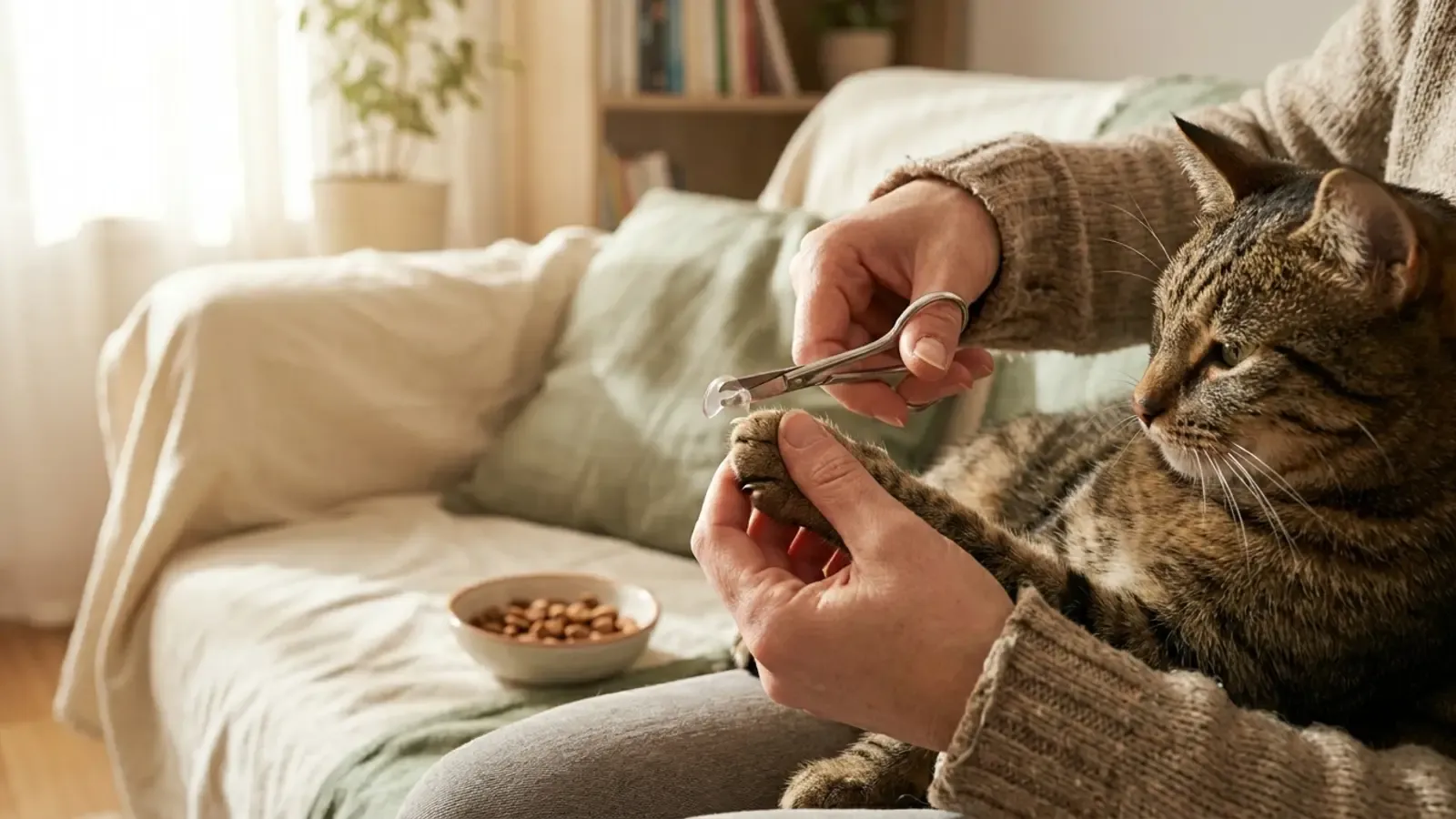
To trim your cat’s nails, wait until they are relaxed, hold a paw gently and press the top of a toe so the claw slides out, find the pink quick inside the claw, and snip only the clear, sharp tip, a couple of millimetres short of the quick. Use proper cat clippers, do one or two claws at a time if your cat is unsure, and give a treat after each one. Never force it.
Not every cat needs regular trims: active outdoor cats often wear their claws down naturally. Indoor cats, kittens and older cats are the ones most likely to need help.
Does my cat need a nail trim?
Trim only when the claws are too long, not just because they feel sharp. The PDSA lists the signs that claws are too long:
- Claws catch on carpet, blankets or clothes
- You hear them click on hard floors
- You can see the claws even when your cat is resting
- The claws are starting to curve round
Check long-haired cats carefully, as fur can hide overgrown claws. Older cats are most at risk: they scratch less, and their claws can thicken and curl round into the paw pad, which is painful and needs a vet. If you see a claw growing into a pad, or blood or swelling around a toe, don’t try to fix it at home: call your vet.
How often to trim
There is no single rule. The AAFP notes that kittens, indoor-only and older cats need more regular trims, while outdoor cats may need them rarely. Many indoor cats need a trim every few weeks. A simple approach is to check the claws every two weeks and trim the ones that need it.
What you need
- Cat nail clippers: small scissor-style or guillotine-style clippers made for cats. Human clippers and scissors can crush and split the claw.
- Treats your cat loves
- Good light, so you can see the quick
- Cornflour or styptic powder and some cotton wool, just in case
- Optional: a towel to wrap a wriggly cat, and a helper to stroke and feed treats
Finding the quick
Each claw has a pink core, the quick, which contains blood vessels and nerves. Cutting into it hurts and bleeds. In pale claws, it is easy to see as a pink triangle running from the toe towards the tip. Cut only the clear, white part beyond it, leaving a couple of millimetres of space.
If your cat has dark claws and you can’t see the quick, take off only the very tip, the sharp hook, and stop there. Little and often is safer than one big cut.
Step by step
- Pick the moment. Choose a time when your cat is sleepy and relaxed, such as after a meal or a nap, in a quiet room.
- Get comfortable. Sit with your cat on your lap facing away from you, or on a table on a non-slip mat. If they wriggle, wrap them loosely in a towel with one paw out.
- Let them sniff the clippers and give a treat.
- Hold a paw gently. Press lightly on the top of a toe and the pad underneath; the claw will slide out.
- Find the quick, then snip off the sharp tip in one smooth cut, a couple of millimetres in front of the quick.
- Release, reward. Give a treat or praise after each claw, or each paw.
- Do the dewclaws. Cats have a “thumb” claw on the inside of each front leg, higher up than the others. It never touches the ground, so it can overgrow quickly.
- Check the back paws. Many cats keep these shorter naturally, but trim them if they are long.
- Stop while it is going well. If your cat gets restless, stop. You can do the rest tomorrow, even one paw a day.
Expect your cat to have a good scratch afterwards, as they tidy up the newly cut tips. A sturdy scratching post helps; see how to stop a cat scratching furniture.
If you cut the quick
It happens, even to vets. Stay calm:
- Press a pinch of cornflour or styptic powder onto the end of the claw, or hold clean cotton wool against it, until the bleeding stops.
- Keep your cat calm and give them a treat when it’s over.
- If the bleeding doesn’t stop after a few minutes of pressure, or the toe looks swollen or sore over the next days, call your vet.
Leave the remaining claws for another day so your cat doesn’t link the clippers with pain.
How to get a nervous cat used to nail trims
Most cats who hate nail trims have learned that being held means something unpleasant. The fix is to rebuild it in small, rewarded steps, over days or weeks. Move on only when your cat is relaxed at each stage.
| Stage | What you do | Move on when |
|---|---|---|
| 1. Paw touches | Briefly touch a front paw while your cat is relaxed, then give a treat | Your cat doesn’t pull away |
| 2. Hold and press | Hold the paw for a few seconds and gently press a toe so one claw shows, then treat | Your cat stays relaxed |
| 3. Meet the clippers | Let them sniff the clippers; touch them to a claw without cutting, then treat | No flinching |
| 4. One claw | Trim a single claw, then a big reward and stop | Your cat stays settled |
| 5. Build up | One more claw at a time, over several sessions | All claws, in one or two sessions |
A few rules that make a big difference:
- Keep sessions short: a minute or two is plenty.
- Never shout, scold or hold your cat down tightly. The PDSA warns this makes future trims harder.
- Always end on a good note, even if that is a single touch of a paw.
- If your cat is very anxious or the claws are already overgrown, ask your vet or vet nurse to trim them and show you how.
This kind of gradual training is exactly what PetTrackr’s cat nail trim course is built around: four small steps from paw touches to the first clipped claw, one short lesson a day, moving on only when your cat is ready.
Nail trims and older cats
Arthritis and less activity mean older cats often need trims more often, while also finding handling more uncomfortable. Be extra gentle with stiff legs, hold each paw low and close to the body rather than stretching it out, and check their claws regularly, including the dewclaws. Claws that keep overgrowing despite trims, or a cat who has stopped scratching altogether, are worth mentioning to your vet. Our senior cat care guide covers more.
PetTrackr helps you keep track. It is not veterinary advice: if your pet seems unwell, call your vet.
 How often to clean a litter box
 How to introduce a new cat
 Pet medical records to keep