
How to trim dog nails
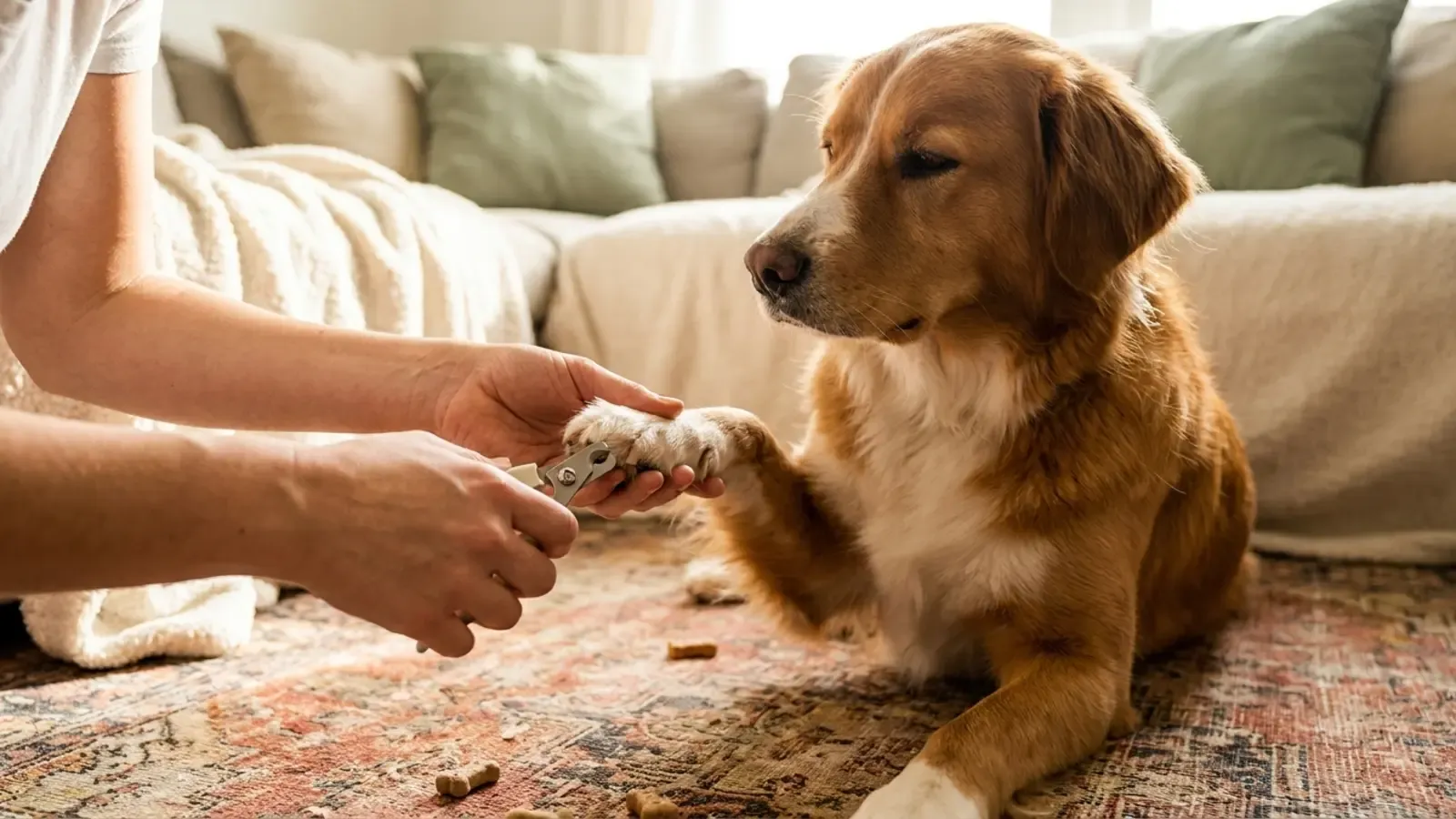
To trim your dog’s nails, hold the paw firmly but gently, and snip a small sliver off the tip of each nail with sharp dog clippers, cutting from underneath at an angle and stopping well before the pink quick. On dark nails, take off tiny pieces until you see a grey-to-pink oval on the cut surface, then stop. Most dogs need a trim every three to four weeks, and a nervous dog can learn to accept it with short, rewarded practice sessions.
How often to trim your dog’s nails
There is no fixed calendar, because nails grow at different speeds and some dogs wear theirs down on pavements. As a rough guide, most dogs need a trim every three to four weeks. Check your dog’s nails every couple of weeks and trim when:
- You can hear them clicking on hard floors
- The nails touch the ground when your dog is standing still
- They are starting to curve or catch on carpets
Long nails aren’t just cosmetic. (Trimming a cat? See how to trim cat nails.) They push the toes sideways when your dog walks, can make walking uncomfortable, can split or snag, and dewclaws can grow round into the pad.
| Dog | Typical trim interval |
|---|---|
| Walks mostly on grass or carpet | Every 3–4 weeks, sometimes more often |
| Walks a lot on pavement | Less often; check monthly |
| Senior or less active | Often more often, as nails wear less |
| Puppy | Small, frequent trims to get them used to it |
| Dewclaws (any dog) | Check at every trim; they never wear down |
Understanding the quick
Inside each nail is the quick: a blood vessel and nerve. Cut into it and it hurts and bleeds, and your dog will remember. Washington State University’s vet hospital advises not cutting within about 2 mm of the quick.
- Light or white nails: you can usually see the quick as a pink area inside the nail. Trim well short of it.
- Black or dark nails: you can’t see the quick from outside. Trim in several tiny cuts. After each cut, look at the end of the nail: when a grey-to-pink oval or a dark dot appears in the middle, stop.
If nails have been left long for a while, the quick grows longer too. Little and often trims help it recede over time; don’t try to take long nails back in one go.
What you need
- Dog nail clippers: scissor style or guillotine style, sharp, sized for your dog. Blunt clippers crush the nail.
- Or a nail grinder, if you and your dog prefer it.
- Styptic powder, just in case. Cornstarch or plain flour works in a pinch.
- Treats: lots of small, tasty ones.
- Good light and a comfortable spot.
How to trim dog nails, step by step
- Pick a calm moment, such as after a walk when your dog is tired.
- Get comfortable. Small dogs can sit on your lap; larger dogs can lie on their side or sit beside you. A second person offering treats or a lick mat helps a lot.
- Hold the paw firmly but gently. Press lightly on the pad to extend the nail. Push any fur back.
- Position the clippers so you cut from underneath at about a 45-degree angle, with the cutting blade facing you, as WSU describes.
- Snip a small piece off the tip. Just the hooked end. When in doubt, take less.
- Check the cut surface on dark nails before taking any more.
- Treat and praise after every nail, or every paw, depending on your dog.
- Don’t forget the dewclaws, on the inside of the leg, if your dog has them.
- Stop while it’s going well. You don’t have to do all four paws at once. Two nails today and two tomorrow is fine.
Using a grinder instead
A grinder sands the nail down a little at a time and leaves a smooth edge. Touch it to the nail for a second or two, then move away, so the nail doesn’t heat up. Keep long fur away from the spinning head. Many dogs need to be introduced to the sound and vibration slowly first.
How to help a nervous dog
Many dogs dislike nail trims, often because of one bad experience. Forcing it usually makes the next time worse. Instead, break it into tiny steps and move on only when your dog is relaxed at each one. Stop if your dog pulls away, freezes, licks their lips, yawns or shows the whites of their eyes, and go back a step next time.
| Step | What you do |
|---|---|
| 1 | Touch a paw briefly, treat. Repeat on all four paws |
| 2 | Hold a paw for a second or two, then longer, treating each time |
| 3 | Show the clippers, treat. Leave them lying around near meals |
| 4 | Touch the clippers to a nail without cutting, treat |
| 5 | Squeeze the clippers near the paw so your dog hears the click, treat |
| 6 | Trim the very tip of one nail, big reward, finish |
| 7 | Build up, a nail or two at a time |
Keep sessions to a minute or two, once or twice a day. The same small-steps approach works for brushing teeth. This can take days for some dogs and weeks for others. If you would like a plan to follow, the PetTrackr training courses include a nail-trim course that takes you through these steps one day at a time and tells you when your dog is ready for the next.
Some dogs are so anxious that home trims aren’t safe for either of you. Your vet, a vet nurse or a groomer can do them, and your vet can talk to you about options for very fearful dogs. There is no prize for doing it yourself.
What to do if you cut the quick
It happens to everyone eventually. Don’t panic; your dog will take their cue from you.
- Press styptic powder onto the end of the nail. Dip the nail into a little powder or press it on with a damp cotton bud. Cornstarch or flour works if that’s all you have.
- Hold gentle pressure for a minute or two. Lifting too soon can restart the bleeding. WSU notes that without styptic powder, bleeding may take about 5 minutes to stop.
- Keep your dog quiet for a while afterwards, so they don’t knock the nail.
- Give that nail a few days before trimming it again.
Call your vet if the bleeding doesn’t stop after 5 to 10 minutes of pressure, the nail is split or torn, your dog is in a lot of pain, or the toe later looks swollen or infected.
Quick checklist
- Trim every 3–4 weeks, or when nails click on the floor
- Sharp clippers, styptic powder, treats
- Cut from underneath, small slivers, stop before the quick
- Dark nails: look for the grey-pink oval
- Don’t forget dewclaws
- Short, happy sessions beat one big battle
PetTrackr helps you keep track. It is not veterinary advice: if your pet seems unwell, call your vet.
 How much exercise does a dog need?
 How to remove a tick from a dog
 Pet medical records to keep