
How to give a cat a pill
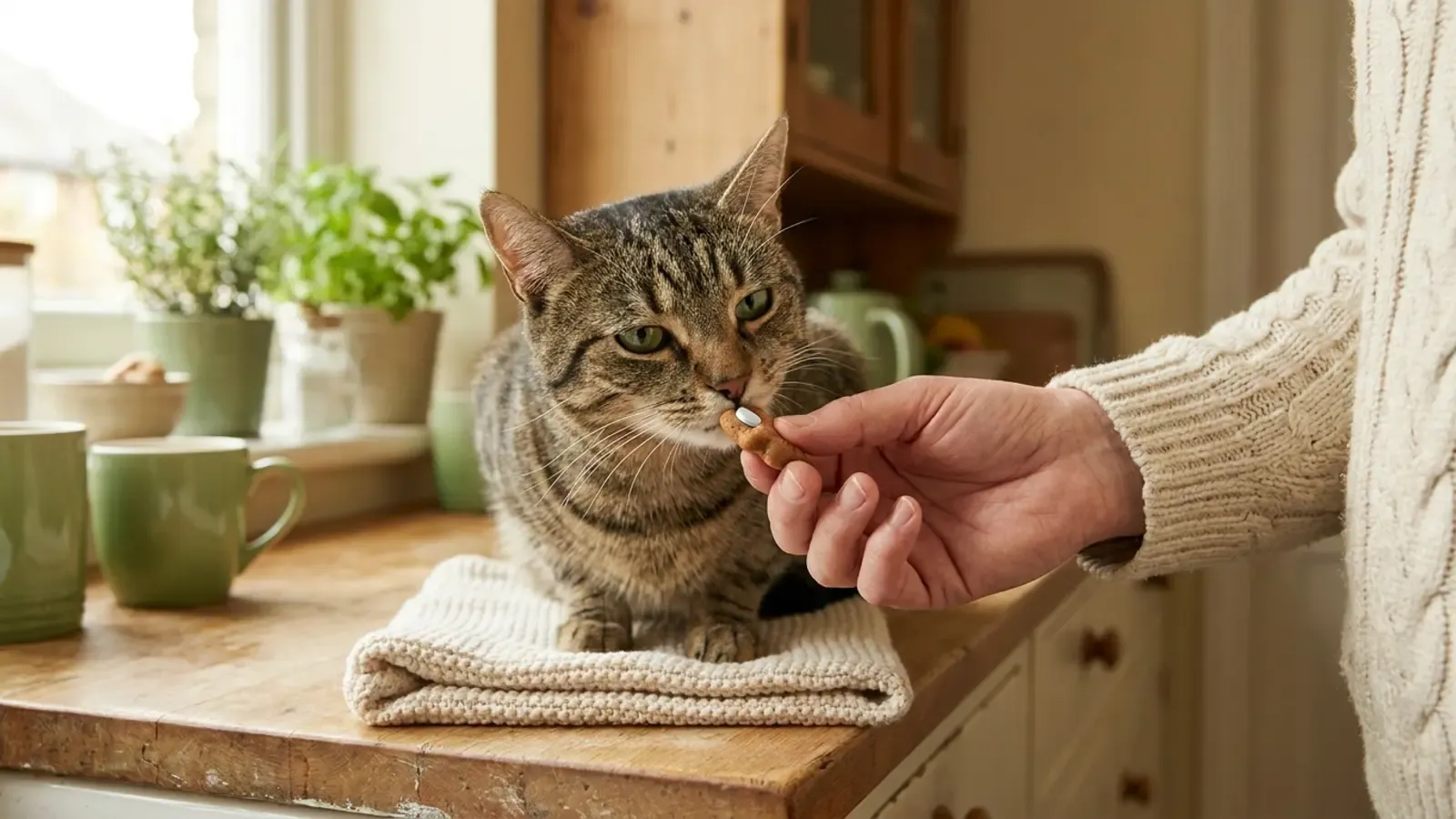
To give a cat a pill, either hide it in a small amount of a favourite soft food (if your vet says it can go with food), or tilt the head back, gently open the lower jaw, and drop the pill as far back on the tongue as you can, then close the mouth and stroke the throat until they swallow. Whichever way you do it, follow every pill with about a teaspoon of water or a little food: a dry tablet can stick in a cat’s food pipe and cause real damage.
Before you start
- Check the instructions. Some tablets must be given with food, others on an empty stomach. Ask if you’re not sure.
- Ask before splitting or crushing. Some tablets have a coating that matters, and crushed tablets taste so bitter that many cats foam at the mouth and refuse their food for days.
- Get everything ready first. Pill out of the packet, water syringe filled, treat in reach, towel nearby. Cats read the preparations, so do them out of sight.
- Pick a calm moment. Not straight after a fright, and not by chasing them out from under the bed.
- Choose a good spot. A table or worktop with a towel on it works better than the floor: the cat is at your height and has less grip to push away.
Method 1: hide it in food
Cats are far fussier than dogs about pills in food, but it works well for some.
- Use a small amount of something strongly flavoured: a pill pocket treat made for cats, a lick of their favourite wet food, a little meat paste, or a creamy lickable cat treat.
- Offer a plain bite first, then the one with the pill, then another plain bite.
- Don’t mix it into a full meal. Your cat may eat around it, or go off that food altogether if they taste the pill. International Cat Care also advises against hiding pills in the main meal for this reason.
- Check afterwards that the pill hasn’t been left in the bowl or spat out behind the sofa.
- Avoid foods that are unsafe for cats, such as onion, garlic and chives; see foods toxic to cats.
Method 2: give it by hand
This is often quicker and less stressful than days of failed attempts with food. It is easier with two people, one to hold and one to give the pill, but can be done alone with a towel.
Holding your cat
- With a helper: sit the cat on a non-slip surface facing away from the person holding, who gently holds each front leg just above the elbow.
- On your own: wrap your cat snugly in a towel with only the head out, a “purrito”. This stops paws getting in the way and many cats feel more secure. Then sit them on your lap or tuck them against your body.
- Never hold harder than needed. If your cat is struggling hard or trying to bite, let go, wait, and try later. Forcing it only makes the next dose harder.
Step by step
- Hold the pill between the thumb and index finger of your dominant hand. A dab of butter or wet food on it helps it slide down.
- Hold the head from above with your other hand, thumb on one side of the cheekbones and fingers on the other.
- Tilt the head back until the nose points to the ceiling. The lower jaw will usually drop open slightly.
- Open the mouth wider by pressing gently on the small front teeth of the lower jaw with the ring or little finger of the hand holding the pill.
- Drop the pill well back on the middle of the tongue, past the hump, and quickly close the mouth.
- Bring the head back to level and hold the mouth closed gently.
- Encourage a swallow by stroking the throat or blowing lightly on the nose. A lick of the nose usually means the pill has gone.
- Follow with water or food (see below).
- Reward straight away with a treat, a fuss or a quick game, so the session ends on something good.
Using a pill giver
A pill giver (pill gun or pill popper) is a plastic syringe-like tool that holds the tablet in a soft tip and pushes it onto the back of the tongue when you press the plunger. It keeps your fingers away from teeth and works well for many cats. Ask your vet clinic for one and to show you how; be gentle and don’t push it too far down the throat.
Always follow a pill with water or food
This is the step most people miss, and it matters. In cats, tablets and capsules often stay in the food pipe (oesophagus) for minutes after a “dry” swallow instead of reaching the stomach. Research tracking tablets in cats found that following them with a small amount of water got them to the stomach quickly. A tablet that lingers can irritate and burn the lining (oesophagitis). Over time that can heal as a stricture, a narrowing that makes swallowing difficult and can need repeated procedures to fix.
The antibiotic doxycycline is the medicine most often linked to this in cats, and the antibiotic clindamycin has been too, but it is good practice for every tablet and capsule:
- Gently squirt about 5 to 6 ml of water (just over a teaspoon) into the side of the mouth with a needle-free syringe, a little at a time so they can swallow, or
- Offer a small amount of wet food or a lickable treat straight after the pill.
Never pour water into the mouth with the head tipped back: give it slowly into the cheek pouch with the head level, so your cat swallows rather than inhales it.
Call your vet if, during or after a course of tablets, your cat drools, gulps, retches, regurgitates food, or seems to have trouble swallowing.
If pilling isn’t working
You don’t have to keep fighting. Ask your vet about:
- Liquid versions of the medicine, given by syringe into the cheek pouch
- Compounded medicines, where a pharmacy makes the drug into a flavoured liquid, chew or treat (tuna, chicken or fish flavours are common), if it is safe for that drug
- A gel rubbed onto the inside of the ear, available for a few medicines
- Long-acting injections that replace a course of tablets for some conditions
- A demonstration. A nurse or technician can show you the technique, which makes a big difference.
If a dose goes wrong
- Your cat spat it out intact: try again, or try a different method.
- You’re not sure it was swallowed, or your cat vomited soon after: don’t give another without checking with your vet.
- Foaming or drooling after a bitter tablet: common and usually brief. Offer a treat or water. Tell your vet so they can suggest a coated or flavoured form.
- A missed dose: check the label or ask your vet before doubling up.
Keeping a course on track
Cats often need a course of tablets for days or weeks, and some need daily medicine for life (thyroid or heart medicine, for example). Doing it at the same time each day, linked to a meal or routine, helps both of you. PetTrackr reminds you when each dose is due, lets you mark it given from the notification, and keeps count of the doses left, so you don’t have to remember whether this morning’s pill went in, or who in the house gave it.
PetTrackr helps you keep track. It is not veterinary advice: if your pet seems unwell, call your vet.
 Cat drinking a lot of water?
 Cat hairballs
 Cat peeing outside the litter box