
How to crate train a puppy
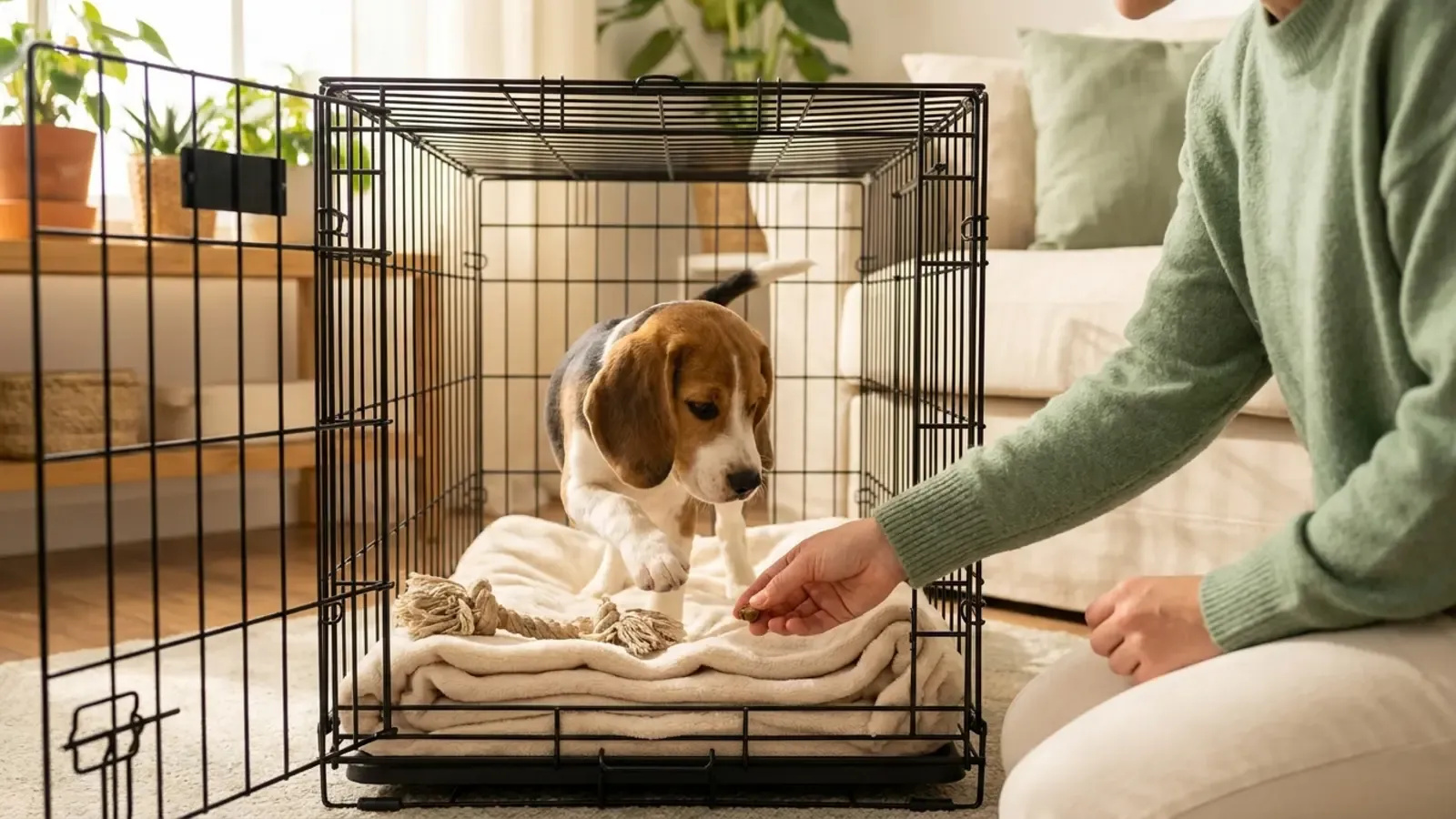
To crate train a puppy, make the crate the best place in the house before you ever close the door: leave it open with a comfy bed and toss treats inside, feed meals in it, then close the door for a few minutes while you are home and build up slowly. Puppies under six months shouldn’t be crated for more than about three or four hours at a time during the day, and a crate is never used as a punishment.
Done gently, a crate gives your puppy a safe den to rest in, keeps them out of trouble when you can’t watch them, and makes potty training much easier, because most puppies try not to soil where they sleep.
Choosing the crate
- Size: big enough for your puppy to stand up, turn around and lie down comfortably. Too big, and they may use one end as a toilet. If you buy one for adult size, use a divider panel and move it back as your puppy grows.
- Type: wire crates are airy and often come with dividers; some puppies settle better with a blanket over part of it for a cosy, den-like feel. Leave the front and some sides uncovered for air.
- Place: somewhere your family spends time, not a cold utility room. At night, next to your bed to begin with.
- Inside: a soft bed (unless your puppy shreds or wets it), a safe chew toy and, for longer stays, water in a spill-proof bowl or bottle.
- Collar off. The AKC advises removing collars and harnesses in the crate, as they can catch on the wire.
Crate training step by step
Go at your puppy’s pace. Move to the next step only when they are relaxed at the current one, and go back a step if they start to worry.
Step 1: Make it a great place to find things
Leave the crate door open (fix it so it can’t swing shut and startle them). Drop treats and toys just inside, then further back. Let your puppy go in and out freely. Praise them when they choose to go in. Never push or carry them in.
Step 2: Feed meals in the crate
Put each meal near the front, then gradually move the bowl to the back. Once your puppy is eating calmly inside, close the door while they eat and open it as soon as they finish. Over several meals, leave it closed a little longer afterwards, building to around 10 minutes.
Step 3: Short closed-door stays while you are home
Give your puppy a long-lasting chew or a stuffed, frozen food toy, close the door and sit nearby. Open it before they get worried. Build up a few minutes at a time, then start moving around the room, then out of sight briefly. Work towards about 30 minutes of quiet resting while you are home.
Step 4: Short absences
Once your puppy is happy for 30 minutes with you around, start leaving the house for short trips: the AKC’s advice is to go for a coffee, not out for dinner. Keep arrivals and departures calm and low-key. Make sure your puppy has been to the toilet and had some play first, so they are ready to rest.
Step 5: Nights
Put the crate next to your bed. Take your puppy out to the toilet last thing, then settle them in with a chew. Young puppies often need a toilet trip during the night at first. If they wake and cry, take them out calmly on a lead, let them go, and put them straight back with no play. Over time the night-time trips stop, and you can move the crate gradually if you want to.
How long can a puppy stay in a crate?
These are maximums for a puppy who is already happy in their crate, not targets. Many young puppies need to go out sooner, especially after waking, eating, drinking or playing.
| Puppy’s age | Daytime maximum in the crate (rough guide) |
|---|---|
| 2 months (8–9 weeks) | Up to about 2–3 hours, often less |
| 3 months | Up to about 3 hours |
| 4–6 months | Up to about 3–4 hours |
| Adult dog, fully house-trained | No more than about 4–5 hours during the day |
The usual rule of thumb is the puppy’s age in months plus one, in hours, and Humane World for Animals advises that puppies under six months shouldn’t be crated for more than three or four hours at a time during the day. Overnight is different, because a sleeping puppy can hold on longer, but young puppies still often need one trip out.
If you work long days, arrange a dog walker, a puppy sitter or a friend to visit, or use a larger puppy pen with a toilet area. A crate is for rest, not for spending most of the day in. Dogs kept crated day and night can become anxious or depressed.
Whining and crying
- Cries the moment the door closes: you have moved too fast. Go back to shorter stays with the door open and build up more slowly.
- Whines after settling for a while: they may need the toilet. Take them out on a lead, calmly, with no play, and bring them back.
- Whining for attention: if you know they have been out, give it a few minutes before reacting, and let them out when they are quiet.
- Panic: drooling, frantic scratching at the door, hurting themselves trying to escape or soiling in distress are not normal settling-in noises. Stop crating and speak to your vet or a reward-based trainer, as it can be a sign of separation anxiety.
Never punish whining or crying. It doesn’t teach a puppy to be calm, it teaches them the crate is scary.
Never use the crate as a punishment
The crate only works if your puppy loves it. Shutting them in after a telling-off teaches them to dread it, and the American Veterinary Society of Animal Behavior recommends reward-based training for all dogs. If you need a break from a wild puppy, give them a chew in the crate calmly, as a rest, not a sentence.
A few other rules:
- Not straight after a big meal or a big drink without a toilet trip first.
- Not in hot spots such as a sunny window or near a radiator, and never in a hot car.
- Not for hours on end. Make sure your puppy gets plenty of play, training, walks (once vaccinated) and time with you outside it.
Getting ready for a new arrival? Our new puppy checklist covers the crate and everything else you will need in the first week.
PetTrackr helps you keep track. It is not veterinary advice: if your pet seems unwell, call your vet.
 Your puppy’s first vet visit
 Puppy teething
 When to spay or neuter your dog or cat