How to potty train a puppy
To potty train a puppy, take them to the same outdoor spot after every meal, nap and play session and every one to two hours while awake, reward them the moment they go, and supervise or confine them the rest of the time so accidents can’t happen. A rough guide to how long a puppy can hold it is their age in months plus one, in hours. Most puppies are reliable by 4 to 6 months, and some take up to a year.
The method is simple. Doing it every day for months is the hard part, so here is the schedule, the reasons behind it, and what to do when it goes wrong.
How long can a puppy hold it?
The common rule of thumb is age in months, plus one, in hours. It is a ceiling for a calm, resting puppy, not a target, and some trainers suggest using just age in months until your puppy has the idea.
| Age | Rule-of-thumb maximum (resting) | Daytime trips while awake | Overnight |
|---|---|---|---|
| 8–10 weeks | about 3 hours | every 1–2 hours, plus after every trigger | usually 1–2 trips |
| 3 months | about 4 hours | every 2–3 hours, plus triggers | often 1 trip |
| 4 months | about 5 hours | every 3–4 hours, plus triggers | some still need 1 trip |
| 5–6 months | about 6–7 hours | every 4 hours or so, plus triggers | most sleep through |
VCA adds that even a resting puppy should go out at least every 4 hours, and that puppies may need a trip in the night until around 5 months. Never stretch a puppy past what they can manage just to hit a number.
The triggers: take them out straight after
- Waking up, from the night or from any nap
- Eating or a big drink of water
- Play, and every half hour or so during a busy play session
- Excitement: visitors arriving, coming out of the crate
- The signs: sniffing the floor, circling, pausing, suddenly wandering off, whining at a door
Step by step
- Pick one toilet spot outside and use the same door to get there every time. The smell of earlier visits helps.
- Go with them, on a lead if needed. You can’t reward what you don’t see, and a puppy left alone in the garden often plays instead.
- Stand still and be boring. Let them sniff. Say your cue word (“be quick”, “go potty”) quietly as they start.
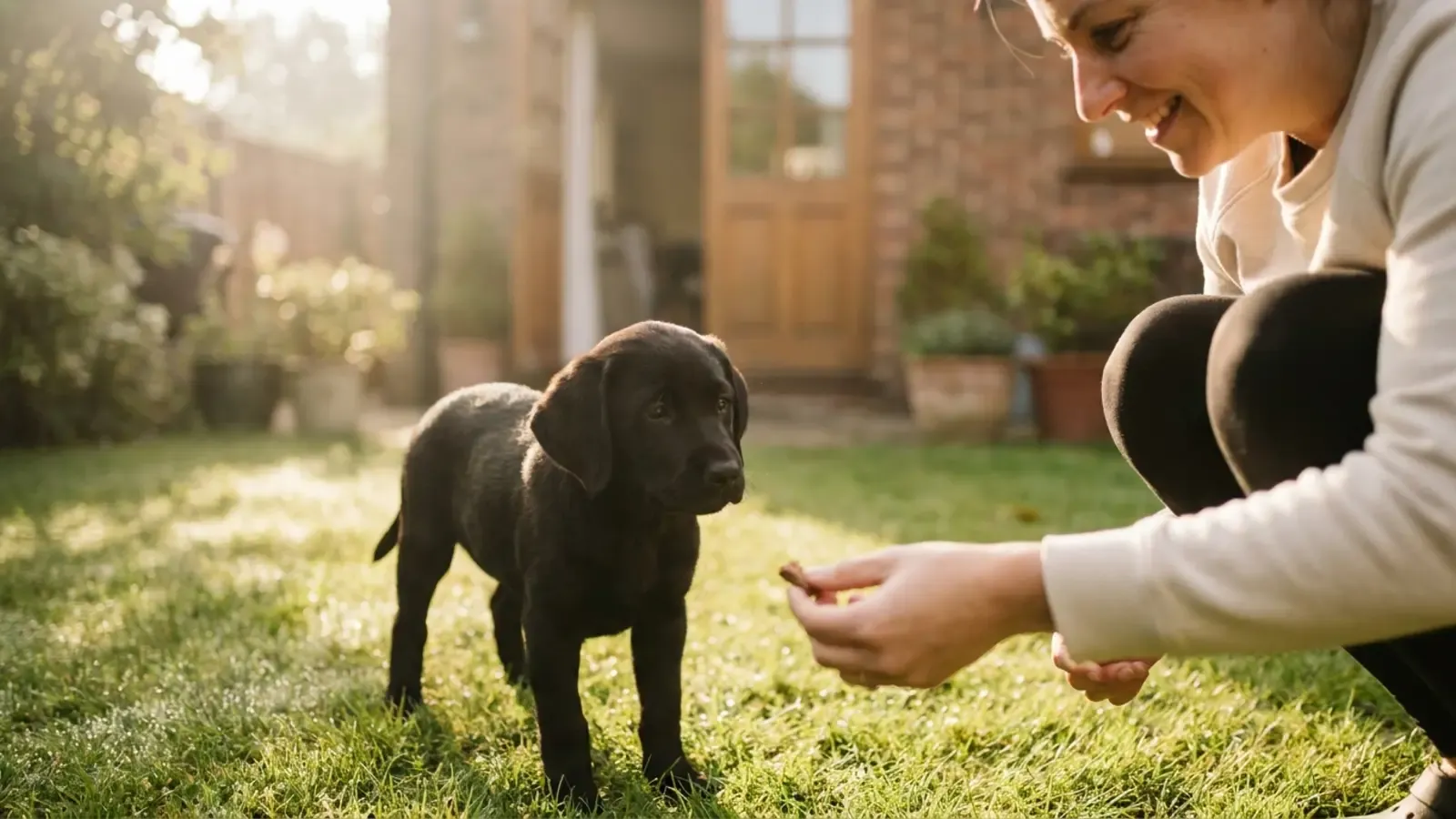
- Reward instantly. Praise and a small treat the second they finish, while still outside. A reward back in the kitchen comes too late.
- Then play. Make playtime and exploring the garden come after the toilet, not before.
- Nothing after 5 minutes? Go back inside, keep them close or in the crate for 10 to 15 minutes, then try again.
- Supervise or confine whenever you are inside. Eyes on them, a lead tied to you, or a crate or pen when you can’t watch.
Using a crate
Dogs naturally avoid soiling where they sleep, which is why a crate helps. It works only if it is the right size: room to stand, turn and lie flat, and no more. Too big, and your puppy will use one end as a toilet. An adult-size crate with a divider grows with them.
- Use it for naps, the night and short spells when you can’t supervise
- Take your puppy out as soon as they come out of the crate
- Don’t leave a young puppy crated for longer than they can hold it. VCA suggests no more than about 3 hours at a time in the day for a young puppy; for longer, arrange a toilet break with a friend or sitter, or use a pen with a toilet area
- Never use the crate as punishment
More in how to crate train a puppy.
A sample daily schedule (8 to 12 weeks)
| Time | What happens |
|---|---|
| 6:30 | Wake up, straight outside. Reward |
| 6:45 | Breakfast, then outside again within 15 minutes |
| 7:15 | Short play and training, outside again |
| 7:45 | Nap in the crate |
| 9:30 | Wake, outside. Play, explore, outside |
| 10:30 | Nap |
| 12:00 | Wake, outside. Lunch, outside |
| 12:30–15:00 | Play and naps, outside after each |
| 17:00 | Dinner, outside |
| 17:30–20:00 | Play, short training, naps, outside after each |
| 21:30 | Last trip outside, then bed |
| Night | One quiet trip out if they wake and cry: no play, straight back to bed |
Feeding at set times makes the toilet predictable too. Most trainers suggest picking up the water bowl an hour or two before bedtime, as long as your puppy has had plenty to drink during the day.
A routine this tight works best when everyone at home follows the same one and knows whose turn the 6:30 trip is. PetTrackr puts toilet trips, meals and naps on one daily plan, lets you assign each one to a person, and reminds them on their own phone.
Accidents
Every puppy has them. How you react decides whether they become fewer.
If you catch them in the act: make a light, surprising sound (a clap or “oops”) to interrupt, scoop them up and take them outside. If they finish there, reward them.
If you find it afterwards: clean it up and say nothing. Your puppy can’t link a puddle from ten minutes ago to a telling-off now. They only learn that you are frightening, and to go where you can’t see them.
Never rub a puppy’s nose in it, shout or hit.
Clean with an enzymatic cleaner. Ordinary cleaners can leave a smell your puppy can still detect, which draws them back. Avoid ammonia-based products, which smell like urine.
Then ask what happened. Too long between trips? Missed a trigger? Too much freedom in a room you weren’t watching? Shorten the gaps for a week.
Puppy pads: yes or no?
Pads are useful for very young puppies, for people in high-rise flats, and for overnight in a pen. They also teach that going indoors is allowed. If you use them:
- Put them by the door you will later use to go out
- Move them gradually closer to the door, then outside
- Phase them out as soon as your puppy can make it outside
If you can get outside easily, going straight to outdoor training is usually quicker.
How long it takes
Most puppies are reliably house trained at 4 to 6 months, and some take up to a year. Small breeds, and puppies that spent a long time in a kennel or cage, often take longer.
Signs you can give more freedom: VCA suggests waiting until your puppy has gone 8 to 12 weeks without mistakes, then opening up one room at a time, for short periods, while you keep an eye out for their signals.
Common problems
| Problem | What usually helps |
|---|---|
| Goes as soon as they come back inside | Too short outside, or too exciting. Wait longer, keep it boring, reward the finish |
| Accidents in the crate | Crate too big, left too long, or a past habit from a dirty kennel. Shrink the space and shorten the time |
| Wees when greeting people or when told off | Excitement or submissive urination, not a training lapse. Keep greetings calm and low-key. Most puppies grow out of it; a behaviour professional can help |
| Won’t go outside in the rain or cold | Go out with them, under an umbrella, and reward lavishly |
| Was trained, now isn’t | Often too much freedom too soon or a change at home. Go back a step. If it is sudden, see your vet |
When to see your vet
Accidents are a training issue most of the time, but call your vet if your puppy:
- Pees very often, in small amounts, or strains
- Has blood in their urine, or it smells unusually strong
- Is drinking much more than usual
- Has diarrhoea, especially with vomiting or tiredness
- Was house trained and suddenly isn’t
A urinary tract infection or a tummy upset can make house training impossible until it is treated.
PetTrackr helps you keep track. It is not veterinary advice: if your pet seems unwell, call your vet.
 Your puppy’s first vet visit
 Puppy teething
 When to spay or neuter your dog or cat