
How to litter train a kitten
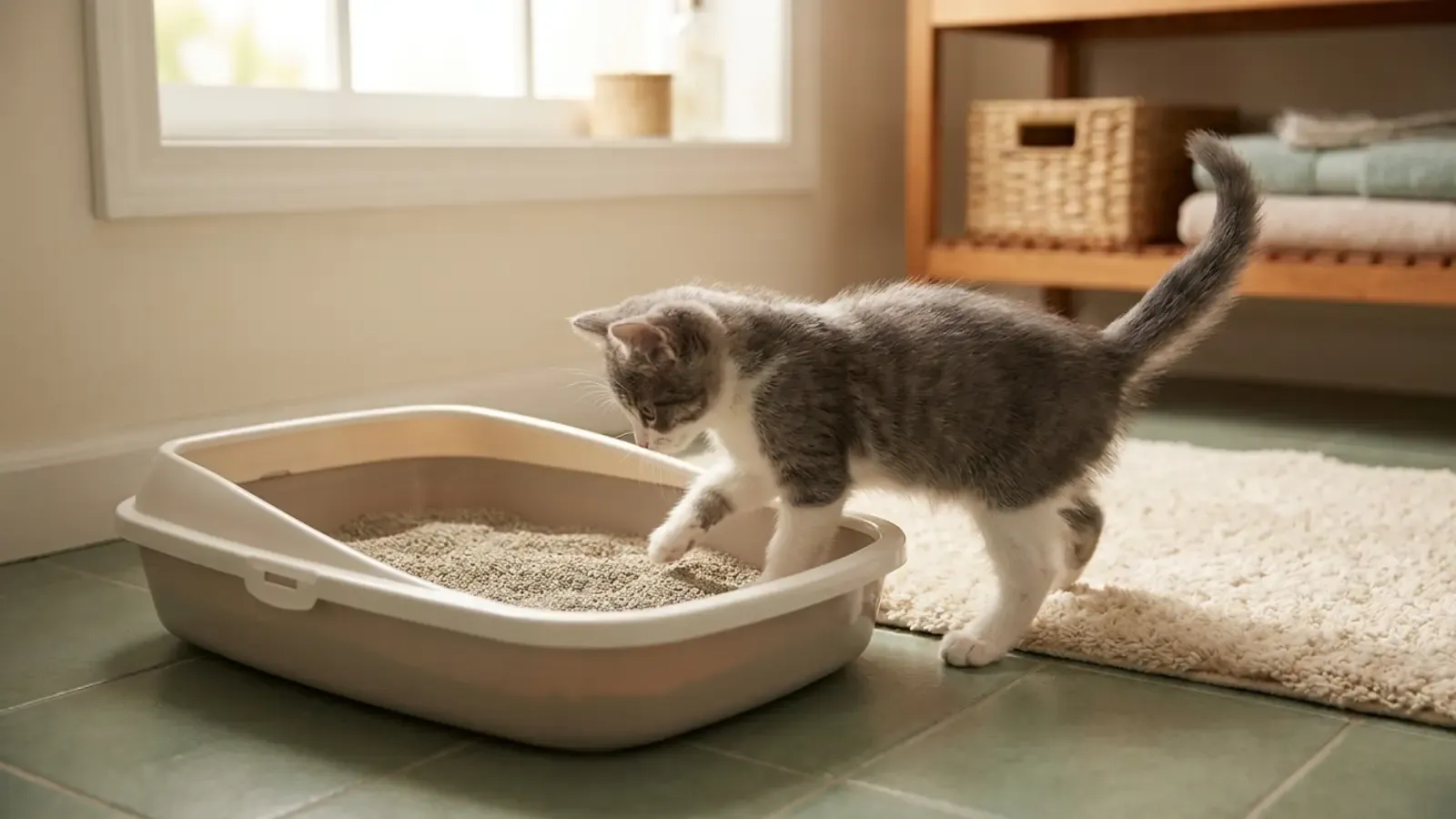
Most kittens already know what a litter tray is for: they learn from their mother, and your job is to give them a tray they can get into easily, in a quiet place, with litter they like, kept clean. Provide one tray per cat plus one, so two for a single kitten. Show your kitten the tray after meals and naps for the first few days, and never punish accidents.
If your kitten is struggling, it is almost always the tray, the litter, the place or the cleaning, so that is what this guide works through.
Set up the right tray
How many trays
The rule cat specialists use is one tray per cat, plus one.
| Cats at home | Trays |
|---|---|
| 1 | 2 |
| 2 | 3 |
| 3 | 4 |
Spread them out. Two trays side by side count as one big tray, and in a multi-cat home one cat can guard a single spot. International Cat Care suggests two trays in separate places within a new kitten’s room, because some cats prefer one for urine and another for faeces, and a tray on every floor of a house with more than one.
Size and shape
- Low sides for a kitten: many adult trays are too high to climb into comfortably
- Big enough to turn and dig. For an adult cat, International Cat Care recommends a tray about one and a half times the cat’s length from nose to base of tail. Plan to upgrade as your kitten grows
- Rectangular gives more room than corner or oval trays
Covered or open?
Covered trays hold in smell and give privacy, but they also hold smell in for the cat, are easy to forget to clean, and some cats feel trapped with one way out. If you use one, take off any flap. If you aren’t sure, offer one of each and let your kitten choose.
Skip disposable liners (claws catch on them) and self-cleaning trays, which can startle a kitten.
Choose the litter
- Start with what they know. Use the litter your kitten used before, then change gradually if you want to
- Fine and soft. Cats generally prefer a fine, sand-like litter over coarse pellets that are hard underfoot
- Unscented. Strong perfumes put many cats off
- About 3 cm deep, enough to dig and cover
- Clumping or not? Many cats prefer clumping litter, and it makes cleaning easier. For very young kittens, under about 8 to 10 weeks, many vets suggest non-clumping litter, because kittens sometimes taste or eat it
Put it in the right place
A good tray spot is:
- Quiet, without sudden noise: not next to a washing machine or boiler
- Away from food and water. Cats don’t like to toilet where they eat
- Away from busy doorways, cat flaps and big windows, where a cat can feel watched or cornered
- Easy to reach at all hours: not behind a door that sometimes shuts
- In the kitten’s room for the first week or two, then also in the main living area as they start to explore
Once a tray is accepted, move it only gradually, a little each day, if you have to move it at all.
Teach your kitten to use it
- Show them the tray as soon as they arrive, and let them sniff and dig.
- Place them in the tray after meals, after waking and after play, especially in the first few days. Most kittens need to go at these times.
- Let them be. Don’t hover or lift them out mid-dig.
- Praise quietly afterwards. Many cats find big fuss off-putting.
- Keep them in one room for the first week or two with the trays close by, so the tray is never far away.
- Open up the house gradually, and keep a tray within easy reach of wherever they spend time.
Kittens under about four weeks, such as orphans being hand-reared, can’t yet control their bladder and need help from a person or their mother. If you are raising a kitten that young, ask your vet how.
Keep it clean
Cats avoid a dirty tray, and that is one of the most common reasons for accidents.
| Job | How often |
|---|---|
| Scoop out solids and clumps | At least once a day; International Cat Care recommends twice |
| Empty, wash and refill (clumping litter) | Every 2 to 4 weeks |
| Empty, wash and refill (non-clumping litter) | Weekly |
Wash trays with hot water and a mild detergent, rinse well and dry. Never use disinfectants that turn cloudy in water, such as some pine and phenol products: they are toxic to cats. More detail in how often to clean a litter box.
When accidents happen
Don’t punish. Shouting at a kitten, or putting their nose in it, teaches them to hide when they need to go, and can turn a small problem into a lasting one.
Clean well. Use a biological (enzyme) cleaner, which breaks down the smell. Avoid ammonia-based cleaners: to a cat, ammonia smells like urine and invites them back.
Then look for the cause:
| What you see | Likely cause | Try |
|---|---|---|
| Goes next to the tray | Tray dirty, too small, or sides too high | Scoop more often, bigger tray with a low entry |
| Goes in one corner of the room | Prefers that spot | Put a tray there, or make the spot less appealing (a food bowl, a toy) |
| Uses the tray for one thing, not the other | Wants separate trays | Add a second tray in another place |
| Goes on soft things (beds, rugs, laundry) | Dislikes the litter, or a medical issue | Try a finer, unscented litter; see your vet if it continues |
| Accidents after a change at home | Stress: new pet, visitors, moving furniture | A quiet base room, trays nearby, a calm routine |
| Accidents far from any tray | Tray too far away | Add a tray closer to where they spend time |
If your kitten keeps choosing the same wrong spot, put a tray right there for a while. Once they use it reliably, move it slowly to where you want it.
When it is a health problem
See your vet promptly if your kitten:
- Strains in the tray, or goes in and out often with little result
- Cries while peeing or pooing
- Has blood in their urine
- Has diarrhoea, or very hard stools
- Was using the tray well and suddenly stops
A cat straining to pee and producing little or nothing is an emergency, especially a male. A blocked urethra can become life-threatening quickly, and the Cornell Feline Health Center says any cat suspected of it needs immediate veterinary care. Don’t wait to see if it passes, and don’t assume it is constipation.
For more on problems in grown cats, see cat peeing outside the litter box.
PetTrackr helps you keep track. It is not veterinary advice: if your pet seems unwell, call your vet.
 When to spay or neuter your dog or cat