
How much do cats sleep?
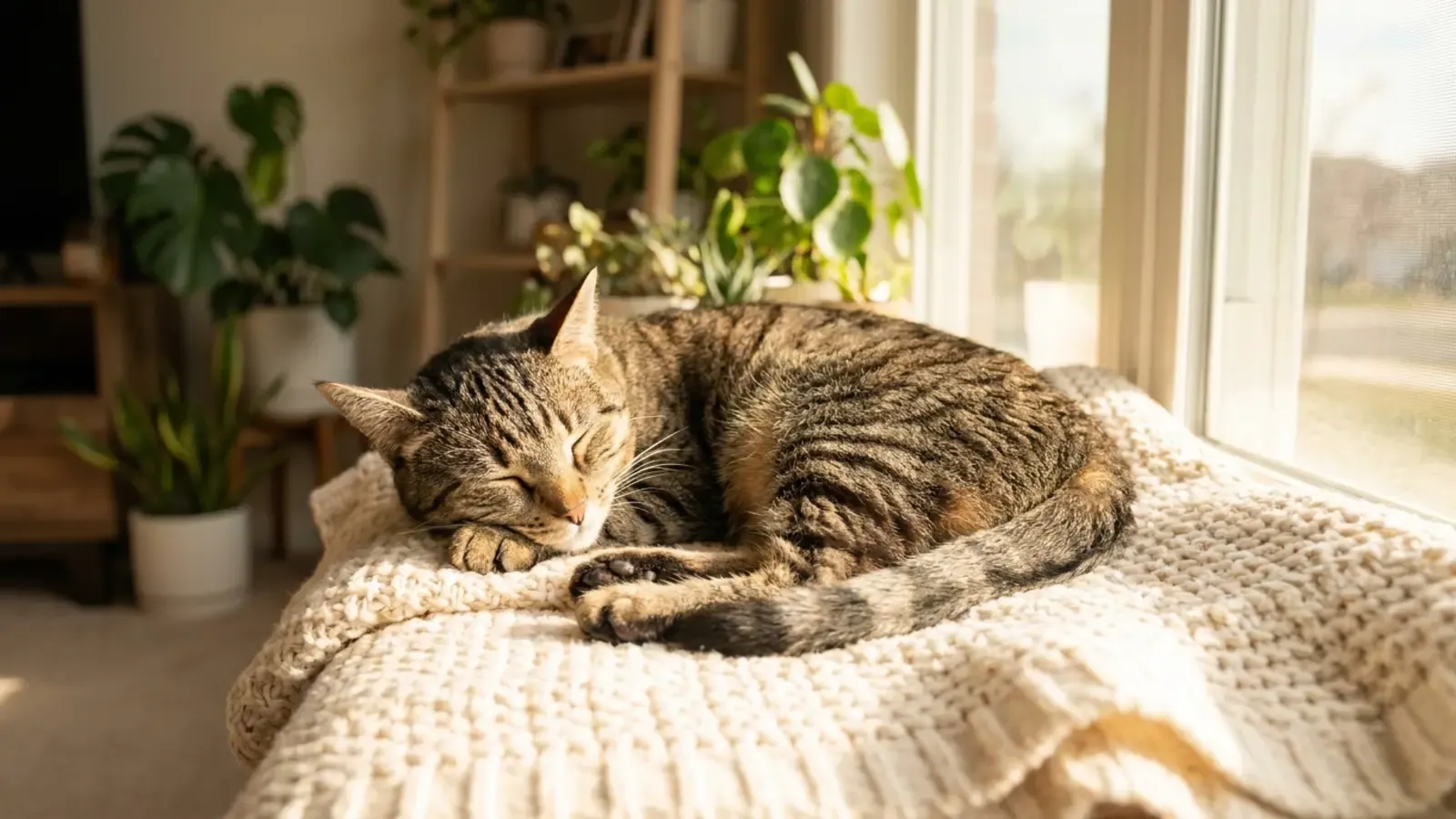
A healthy adult cat sleeps around 12 to 16 hours a day. Kittens sleep more, often 18 to 20 hours, and senior cats creep back up to about 15 to 20 hours. So yes, your cat really does spend most of its life asleep, and that is normal.
What’s worth watching is not the total but a change: a cat that suddenly sleeps much more, or much less, than it used to.
Cat sleep by age
| Age | Typical sleep in 24 hours | What it looks like |
|---|---|---|
| Kitten (up to about 6 months) | 18–20 hours, newborns even more | Bursts of wild play, then deep sleep anywhere |
| Young adult and adult (1–10 years) | 12–16 hours | Long naps through the day, active at dawn and dusk |
| Senior (from about 10–11 years) | 15–20 hours | More and longer naps, less climbing and jumping |
These are the ranges most vets and cat charities quote, and figures vary a little between sources. They include light dozing. Much of a cat’s “sleep” is a light doze with ears still turning towards sounds, punctuated by shorter spells of deep sleep, when you may see twitching paws and whiskers.
Not sure where your cat falls? The cat age calculator shows their life stage in human terms.
Why cats sleep so much
Cats are built as hunters of small prey. In the wild, a hunt is short and intense, and a lot of rest in between saves energy for the next one. Pet cats keep the same rhythm even when the food arrives in a bowl.
Cats are also crepuscular: most active at dawn and dusk. That is why your cat may doze all afternoon, race around at 9 p.m., and wake you before sunrise.
Things that change how much a cat sleeps
- Age. Kittens need the sleep to grow. Older cats sleep more as joints stiffen and energy drops.
- Indoor or outdoor life. Indoor cats with little to do often sleep more out of boredom. Daily play helps.
- Weather. Many cats sleep more on cold or rainy days.
- Weight. Overweight cats tend to be less active. See how to help your cat lose weight.
- Changes at home. A move, a new pet or a new baby can unsettle sleep for a while.
Is my cat sleeping too much?
Cats are very good at hiding illness, and “sleeping more” is often one of the first things an owner notices. Call your vet if extra sleep comes with any of these:
- Eating less, or not at all
- Hiding more than usual, or no longer greeting you
- Grooming less, so the coat looks greasy or unkempt
- Sitting hunched with the eyes half closed, or reluctance to jump
- Drinking much more water, or changes in the litter tray
- Weight loss, vomiting or diarrhoea
- Breathing faster than usual at rest
A cat that stops eating should not be left to “sleep it off”. Cats can become seriously ill if they go without food for even a few days, so call your vet if your cat hasn’t eaten for a day, sooner for a kitten or a cat with a known illness.
Go to a vet straight away if your cat is hard to rouse, collapses, breathes with an open mouth or with obvious effort, cries out when moving, or suddenly can’t use its back legs.
Is my cat sleeping too little?
A cat that can’t settle is worth noticing, especially if it’s new. Common reasons include:
- Hyperthyroidism. An overactive thyroid is common in middle-aged and older cats. It can make cats restless and vocal at night, hungry, thirsty, and thin despite eating well.
- Pain. Arthritis, dental pain or a sore tummy can make it hard to get comfortable. Cats in pain may sleep more or less than usual. See signs of pain in cats.
- Cognitive dysfunction. Older cats can develop a form of dementia that mixes up day and night: sleeping more by day, then pacing and yowling at night. It is diagnosed once other causes have been ruled out.
- Needing the litter tray more often, which can come with kidney disease, diabetes or a urinary problem.
- Boredom or hunger. A cat with energy to burn at bedtime will find ways to use it.
Night-time yowling in a senior cat is a reason for a check-up, not just earplugs. Kidney disease, high blood pressure and hyperthyroidism can all be found with blood tests and a blood pressure reading, and most are very treatable.
Helping your cat sleep well (and letting you sleep)
- Play before bed. Ten minutes with a wand toy, ending in a “catch”, then a meal mimics a hunt, a feast and a nap.
- Keep a routine. Similar feeding and play times help a cat settle into your rhythm.
- Warm, safe spots. Cats like beds that are raised, enclosed or sunny. Older cats appreciate a low, padded bed they don’t have to jump into.
- Easy access for seniors. Steps or ramps to favourite perches, and a litter tray with a low side close to where they sleep.
- Don’t reward the 5 a.m. wake-up. Getting up to feed them teaches them it works. An automatic feeder can help.
Knowing your cat’s normal
Because cats sleep so much anyway, a gradual change is easy to miss. Notes help: roughly how long your cat sleeps, whether nights are calm, and anything new such as yowling or extra trips to the litter tray. PetTrackr logs your cat’s sleep in a tap and shows whether their usual day sits in a healthy range for their age, which makes a change easier to see and easier to describe to your vet.
PetTrackr helps you keep track. It is not veterinary advice: if your pet seems unwell, call your vet.
 Cat drinking a lot of water?
 Cat hairballs
 Cat peeing outside the litter box