
How to help your cat lose weight
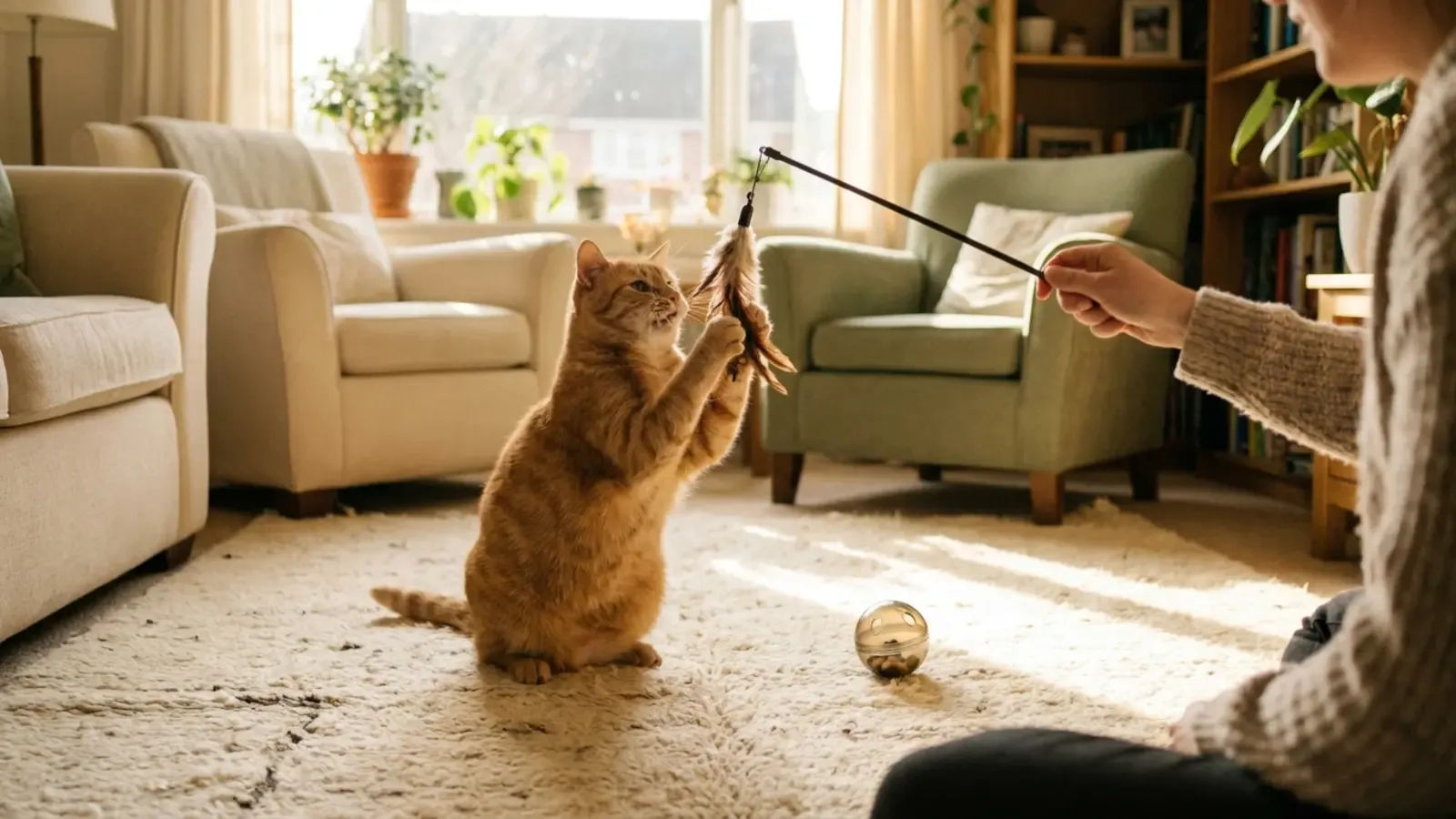
To help your cat lose weight safely, cut calories gently, never drastically, and aim for a slow loss of about 0.5 to 1% of body weight a week, no more than about 2%. Feed for the target weight, weigh every portion, count the treats, make food take effort to find, and play with your cat every day. Start with a vet check.
Slow matters more with cats than with any other pet. Here is why, and a plan that works.
Why cats must lose weight slowly
When a cat eats too little, its body moves fat into the liver faster than the liver can process it. The result is hepatic lipidosis (fatty liver disease), which can be fatal without treatment. Overweight cats are at the highest risk, and it can start after just a few days of eating very little.
That means two rules for any cat diet:
- Never starve a cat to make it lose weight, and never cut its food suddenly by a large amount.
- A cat that stops eating is an emergency in the making. Cornell advises seeing a vet promptly if your cat hasn’t eaten properly for 24 hours.
Warning signs of fatty liver: not eating, rapid weight loss, vomiting, lethargy, drooling, and yellow gums, skin or eyes (jaundice). If you see any of these, call your vet now.
Step 1: see your vet
Your vet can confirm your cat is overweight (VCA defines overweight as 10–20% above ideal weight and obese as more than 20% above), set a target weight, and check for conditions that affect weight, appetite or which diet is safe, such as diabetes, kidney disease or arthritis. Cats that are already losing weight without a diet need checking before anything else.
Step 2: set a gentle pace
| Cat’s current weight | 0.5% a week | 1% a week | 2% a week (upper limit) |
|---|---|---|---|
| 5 kg (11 lb) | 25 g | 50 g | 100 g |
| 6 kg (13.2 lb) | 30 g | 60 g | 120 g |
| 7 kg (15.4 lb) | 35 g | 70 g | 140 g |
| 8 kg (17.6 lb) | 40 g | 80 g | 160 g |
These are tiny amounts, so a cat diet is measured in months. A cat going from 6 kg to 5 kg at 1% a week takes around four to five months, and that is a success, not a slow failure. Your vet may set a nearer first goal for a very overweight cat.
Because the weekly changes are so small, you need a scale that reads in tens of grams: a baby scale, or a kitchen scale with your cat in a box or carrier on top. Weighing yourself with and without your cat on a bathroom scale is too rough to see the trend.
Step 3: work out the calories
Start with the resting energy requirement (RER) for the target weight:
RER = 70 × (target weight in kg)0.75
A common veterinary starting point for weight loss is about 0.8 × RER at the target weight, then adjusted from the weigh-ins.
| Target weight | Daily calories to start (0.8 × RER) |
|---|---|
| 3.5 kg (7.7 lb) | about 145 kcal |
| 4 kg (8.8 lb) | about 160 kcal |
| 4.5 kg (9.9 lb) | about 175 kcal |
| 5 kg (11 lb) | about 185 kcal |
| 5.5 kg (12.1 lb) | about 200 kcal |
| 6 kg (13.2 lb) | about 215 kcal |
If that is much less than your cat eats now, step down over a couple of weeks rather than all at once, and watch that your cat is still eating every meal. More on the formula in how many calories does a cat need?.
Step 4: choose the food
- For a big cut, use a veterinary weight-loss diet. VCA warns that just reducing the amount of a normal food can leave a cat short of essential nutrients over time. Weight-loss diets keep the nutrients while lowering the calories.
- Wet food helps many cats. It is 70–80% water, so a portion looks bigger and fills your cat up for fewer calories. If you mix wet and dry, split the calories between them first.
- Change foods gradually over a week or so, mixing in more of the new one each day. A cat that refuses a new food is a reason to slow down, not to wait it out.
Step 5: feed smarter, not just less
Cats naturally eat many small meals, and an indoor cat with a full bowl in one spot is often eating out of boredom. International Cat Care suggests splitting the daily ration into several small portions and making food part of play.
- Measure the whole day’s food each morning and feed from that, so nothing extra slips in.
- Several small meals suit cats better than one or two big ones; a timed feeder helps if you are out.
- Puzzle feeders and treat balls make your cat work for kibble, which slows eating and adds activity.
- Hide small portions around the house, up and down cat trees, so your cat has to hunt.
- Count the treats. VCA suggests keeping treats to 10% of the day’s calories: on a 300 kcal plan, 270 kcal from the diet and 30 kcal from treats. A few kibbles from the daily ration make perfectly good treats.
More than one cat?
Multi-cat homes are the hardest. Options that work:
- Feed cats in separate rooms and pick up bowls after 20–30 minutes.
- Put the slim cat’s food somewhere high the heavier cat can’t easily reach.
- Use a microchip-activated feeder that only opens for the cat it is programmed for.
Step 6: play every day
Play burns calories, keeps muscle and gives an indoor cat something to do besides wait for dinner. Aim for a few short sessions a day, five to ten minutes each, with a wand toy, a ball, or a toy to chase up the stairs. Let your cat “catch” the toy at the end of each session, and stop if they are panting or lose interest. Heavy cats tire quickly, so build up gradually.
Step 7: weigh, check and adjust
Weigh your cat every two to four weeks while dieting; VCA recommends at least monthly. Check their body shape at the same time: ribs easier to feel, a waist starting to appear.
| What you see | What to do |
|---|---|
| Losing about 0.5–1% a week | Perfect, carry on |
| No loss over two weigh-ins | Check for extras and other people feeding them, then reduce calories by about 5–10% |
| Losing more than 2% a week | Increase the food a little and tell your vet |
| Skipping meals, hiding, vomiting or lethargic | Call your vet now |
Keeping a record makes the slow trend visible, and in PetTrackr a weight goal plans the daily calories for you, places each weigh-in against your cat’s healthy range and flags loss that is going faster than is safe for a cat.
Step 8: keeping it off
When your cat reaches the goal, increase the food gradually to a maintenance amount, and keep weighing monthly. Some cats stay on their weight-loss food with a slightly bigger portion. Keep the puzzle feeders and the play: they are what make the new weight easy to keep.
PetTrackr helps you keep track. It is not veterinary advice: if your pet seems unwell, call your vet.
 Foods toxic to cats