
Cat throwing up

Most cats throw up now and then, and a single episode in a cat who is otherwise bright, eating and using the litter box normally is rarely an emergency. But a cat that vomits regularly, even “just hairballs”, is not normal and should see a vet. Call your vet today if your cat vomits more than once in a short time, there is blood in it, they can’t keep water down, or they seem lethargic, weak or in pain.
Below: how to tell what you are looking at, the common causes, the clear signs of an emergency, and what to tell your vet.
Vomiting, regurgitation or a hairball?
These three look similar on the carpet but mean different things, so it helps to notice what happened just before.
| Vomiting | Regurgitation | Hairball | |
|---|---|---|---|
| What you see first | Drooling, lip-licking, then heaving with strong belly contractions | Little or no warning, no heaving | Hacking, retching, then a tube-shaped wad comes up |
| What comes up | Partly digested food, fluid, foam or bile (yellow) | Undigested food, often tube-shaped, often soon after eating | A cylinder of hair, usually around an inch long |
| Where it comes from | Stomach and upper intestine | Food pipe (oesophagus), before reaching the stomach | Stomach |
Telling them apart is useful, but you don’t have to be sure. Describe what you saw to your vet, and if you can, take a photo or a short video. That alone often saves time.
Common causes of a cat throwing up
Usually less worrying (if it is a one-off)
- Eating too fast, especially in homes with several cats competing for food. A slow feeder or puzzle feeder can help.
- Hairballs. Occasional hairballs are common; see our guide to cat hairballs for how often is normal.
- A sudden change of food. Switch diets gradually over a week or so.
- Eating grass or a plant. Check what it was: some plants are dangerous to cats (see below).
Reasons that need a vet
Cornell Feline Health Center lists a wide range of causes behind vomiting that keeps happening:
- Something they ate: poisonous plants, spoiled food, human medicines, chocolate, onions or garlic, antifreeze. Lilies are especially dangerous to cats, and even small exposures can cause kidney failure. Our list of foods toxic to cats covers the kitchen.
- A foreign body: string, thread, ribbon, hair ties or small objects that block the gut.
- Gut disease: inflammatory bowel disease, food intolerance or allergy, constipation, intestinal parasites, and growths in the gut, including cancer.
- Illness elsewhere in the body: kidney disease, hyperthyroidism, diabetes, liver disease and pancreatitis can all cause vomiting.
Regular vomiting is not normal
Many owners are told that cats “just vomit”, and so they put up with it for years. Vets increasingly disagree. VCA puts it plainly: an occasional hairball is normal, but vomiting more than once or twice a month is not, even if it is only hairballs. Cornell’s advice is to have a cat seen promptly if they vomit more than once a week.
Chronic vomiting is often an early sign of a treatable problem, such as inflammatory bowel disease, food intolerance or hyperthyroidism. Older cats in particular deserve a check, because several of these conditions become more common with age.
When it is an emergency: go to a vet now
Call your vet or an emergency clinic straight away if your cat:
- Vomits repeatedly in a short time, or keeps trying to vomit with nothing coming up
- Has blood in the vomit, or vomit that looks like coffee grounds
- Can’t keep water down
- Seems lethargic, weak, wobbly or collapsed, or has pale gums
- Has a painful or swollen belly, or hides and won’t be touched
- May have eaten something toxic, such as lilies, medicine, antifreeze or a cleaning product
- May have swallowed string, thread or tinsel. If you see string hanging from the mouth or bottom, don’t pull it: it can be wrapped around something inside and cause serious damage
- Also has diarrhoea, especially with blood
- Is straining in the litter box or producing little or no urine, especially a male cat. A blocked bladder can cause vomiting and is a life-threatening emergency
- Is a young kitten, a senior, or has a condition like diabetes or kidney disease
Call for advice (same day) if your cat has vomited more than once, has been vomiting for more than 24 hours, has stopped eating, or just seems “off” to you.
Never give your cat human anti-sickness medicine or painkillers. Many are toxic to cats, and some, like paracetamol, can be fatal.
A one-off episode in a well cat
If your cat vomits once and is otherwise their normal self:
- Clean up and take a quick look at what came up (food, hair, foam, blood, a foreign object).
- Make sure fresh water is available.
- Watch them for the rest of the day: eating, drinking, energy, litter box.
- Note the date and time, and what it looked like.
- If it happens again, or anything else changes, call your vet.
Don’t try to make them vomit, don’t give milk or human medicine, and don’t switch foods abruptly in response.
What to tell your vet
Vets diagnose vomiting largely from the history you give them, then from an exam, blood and faecal tests, and sometimes X-rays, ultrasound or biopsies. The more precise you are, the faster that goes. Try to note:
- When it started, and how often it happens (per day, per week, per month)
- What comes up: food, hair, foam, bile, blood, anything unusual. A photo helps
- Timing: straight after eating, hours later, first thing in the morning
- Appetite and thirst: eating less, drinking more
- Litter box: diarrhoea, constipation, straining, more or less urine
- Weight: any loss, even slow
- Energy and behaviour: hiding, sleeping more, less playful
- Anything new: food, treats, plants, cleaning products, a house move, a new pet
- Medicines they take, including flea treatments
A short log makes this easy. In PetTrackr, you tap to log each episode as it happens, and the symptoms view shows whether it is easing or getting worse, with the dates ready for the vet.
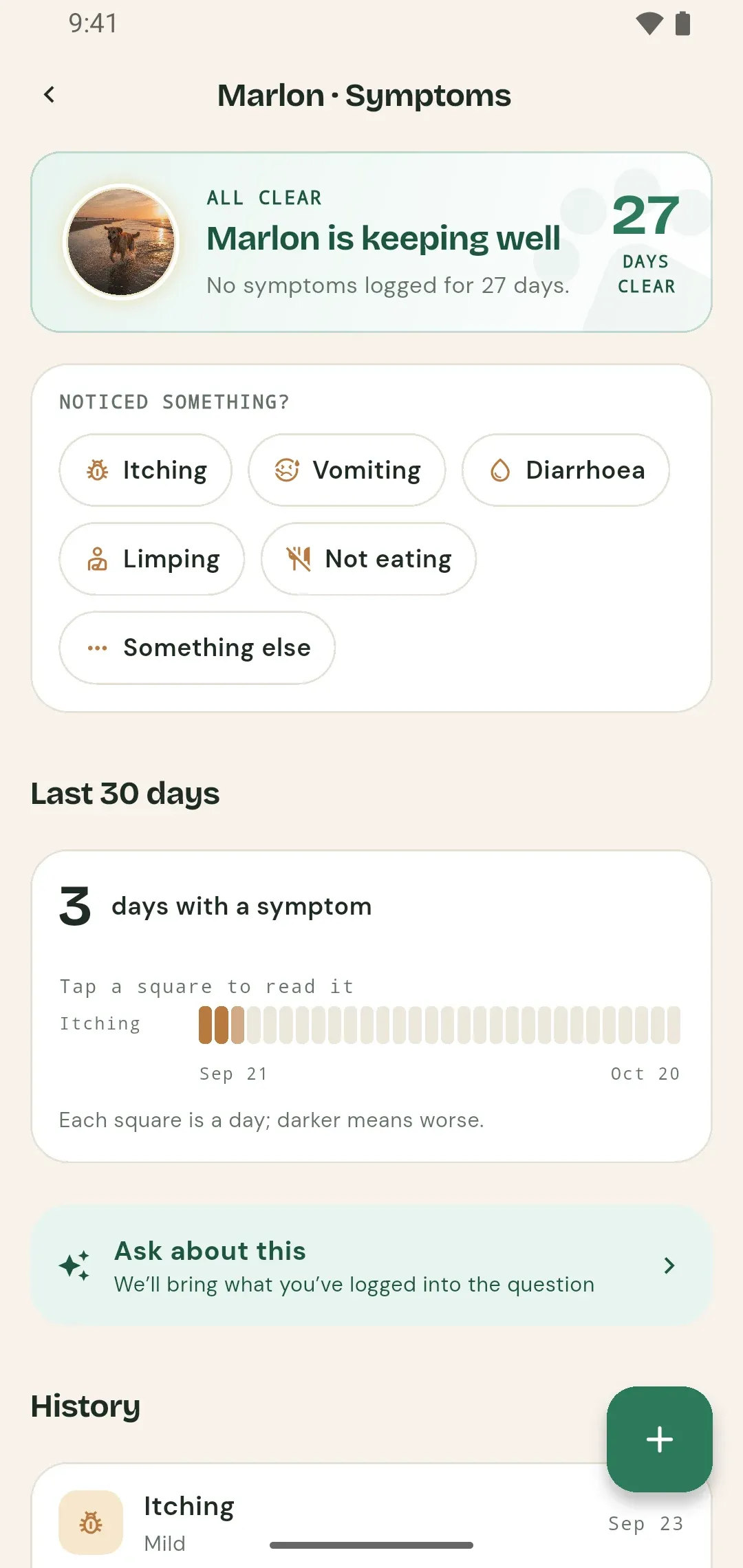
PetTrackr helps you keep track. It is not veterinary advice: if your pet seems unwell, call your vet.
 Cat drinking a lot of water?
 Cat peeing outside the litter box
 How much do cats sleep?