
How to tell a dog’s age
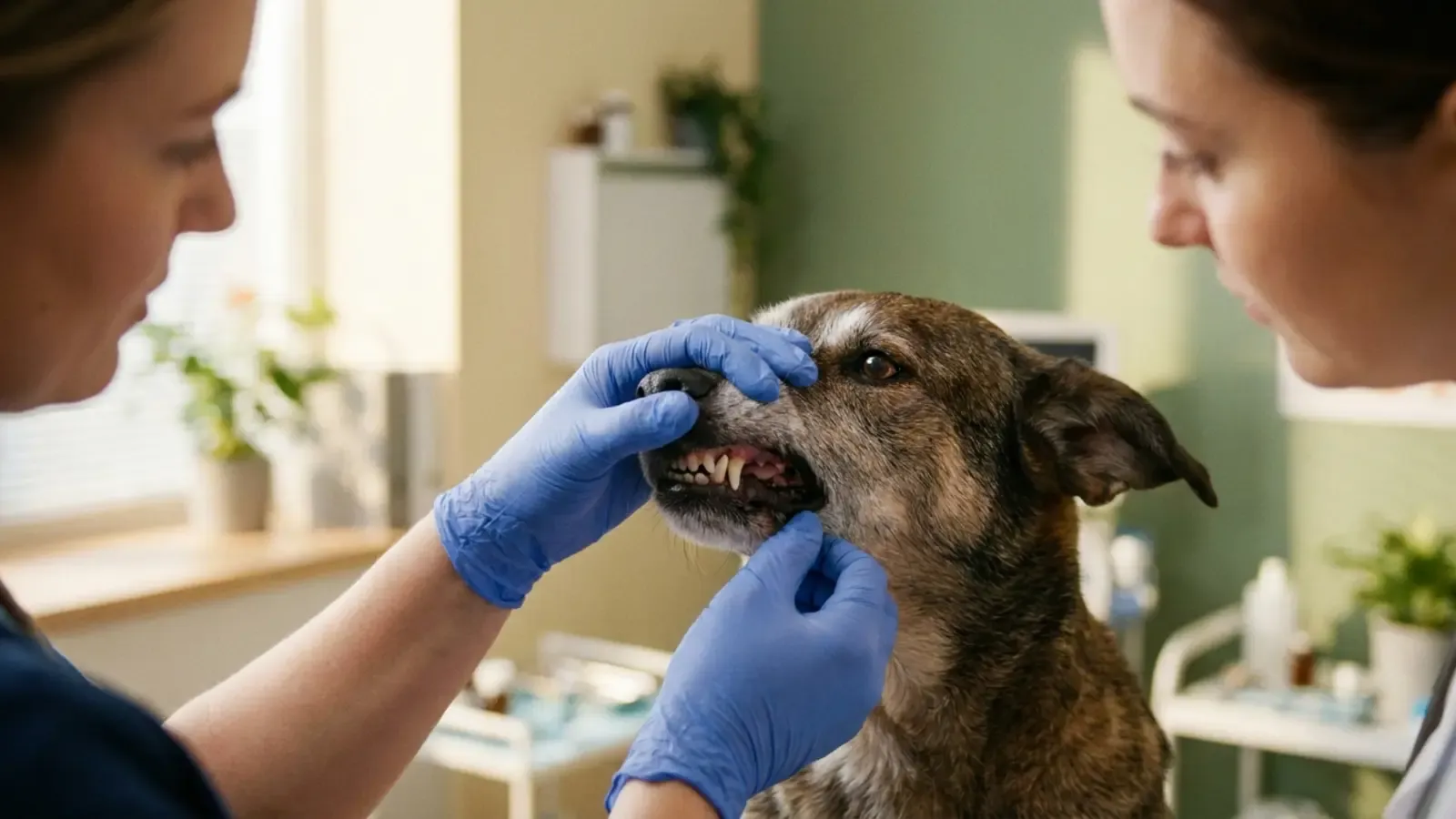
The best way to tell a dog’s age is by their teeth. Puppy teeth and adult teeth come through on a fairly fixed timetable, so a puppy can usually be aged to within a few weeks, and a dog with a full set of clean, white adult teeth is likely to be at least 6 to 7 months old. For adult dogs, vets combine the teeth (tartar, wear, gum health) with the eyes, coat, muscle tone and body shape to give an estimate, which is usually a range of a few years rather than an exact age.
If you have just adopted a dog of unknown age, your vet’s estimate is the most reliable starting point. Here is what they look at, and what you can check yourself.
Puppies: the teeth timeline
Puppies are born without teeth. According to the timeline Vetstreet published with input from a veterinary paediatrics specialist, teeth appear roughly like this:
| Age | What you’ll see |
|---|---|
| Under 3 weeks | No teeth yet |
| 3–4 weeks | Baby canines (the pointed “fangs”) come through |
| 4–6 weeks | Baby incisors (front teeth) and the first baby premolars |
| 6–8 weeks | Last baby premolars. Puppies never have baby molars |
| 8–16 weeks | A full set of 28 sharp baby teeth; little visible change |
| 16–18 weeks | Adult incisors replace the baby ones; first adult premolars and molars |
| 20–24 weeks | Adult canines and more premolars and molars arrive |
| 24–28 weeks | The last adult molars, on the bottom jaw |
By around 6 to 7 months, most dogs have all 42 adult teeth. If you see a mix of tiny, needle-sharp baby teeth and bigger adult ones, the puppy is likely somewhere between 4 and 7 months. Our guide to puppy teething covers what to expect at home.
Two things can throw this off: illness can delay teeth coming in, and very small breeds sometimes keep baby teeth after the adult ones arrive, or have crowded mouths that are harder to read.
Adult dogs: what the teeth show
Once all the adult teeth are in, the teeth stop telling time so neatly. Vets look at:
- Colour and tartar. Young adult teeth are white and clean. Yellowing and tartar build up over the years, starting at the back teeth.
- Wear. The tips of the incisors and canines blunt with age, faster in dogs who chew bones, stones or tennis balls.
- Gum health. Red, receding or inflamed gums and loose or missing teeth are more common as dogs get older.
As a very rough guide, many dogs have bright white teeth around their first birthday, some tartar and yellowing in the following few years, and more tartar, worn tips and gum disease from middle age. But the spread is wide. A small breed with crowded teeth can have dental disease before age 2, and a dog who has had regular dental cleans can have the mouth of a much younger dog. That is why teeth alone can’t pin down an adult dog’s age.
The eyes
Look at your dog’s eyes in good light:
- Bright and clear eyes are typical of young dogs.
- A bluish-grey, see-through haze in the centre of the eye is usually lenticular (nuclear) sclerosis, a normal ageing change. VCA notes it affects about half of dogs over 9 and nearly all dogs over 13, and doesn’t seem to affect vision much.
- A white, opaque patch is more likely a cataract, which blocks light and affects sight. Cataracts can come with age but also with diabetes, injury or genetics, so they are worth showing your vet.
Cloudy eyes, then, suggest an older dog, but the difference between the two kinds of cloudiness is something a vet should check.
The coat
Greying starts on the muzzle and around the eyes and spreads from there. The AKC notes that a dog with a grey muzzle is almost always a mature adult. But greying is one of the least precise signs: some dogs, especially some dark-coated breeds, go grey before age 2, and some never go grey at all.
Other coat and skin changes with age include coarser or thinner hair, a duller coat, and skin that is less elastic. Lumps under the skin also become more common in older dogs, and any new lump is worth a check.
Muscle tone and body shape
Young adult dogs tend to be lean and muscular. With age:
- Muscle fades, especially over the back legs, hips and spine, so the backbone and hip bones can feel more prominent.
- Fat shifts. Middle-aged dogs often gain padding over the lower back and belly.
- Posture changes. Some older dogs develop a dip in the back or stand with their weight shifted forwards off sore hips.
Muscle loss is also a sign of illness and inactivity, so it is a clue about age, not proof.
Energy and movement
Puppies and young dogs are bouncy; older dogs usually slow down, sleep more and may be stiff getting up, especially after rest. Be careful reading too much into this, especially with a newly adopted dog. Energy can take days or weeks to show its real level in a new home, and the AVMA points out that much of what looks like “old age” in a dog, such as reluctance to jump or climb stairs, is often arthritis, which can be treated.
How vets estimate age
There is no single test that gives an adult dog’s exact age. A vet puts together:
- The teeth: eruption in young dogs; tartar, wear and gums in adults
- The eyes: lenticular sclerosis and cataracts
- The coat and skin
- Muscle condition and body shape
- Joints, how the dog moves, and any signs of arthritis
- Sometimes blood tests or X-rays, which can show changes more common in older dogs, such as arthritis in the joints or spine
Size matters too, because large and giant breeds age faster than small ones. A 7-year-old Great Dane may look as old as a 12-year-old terrier.
How accurate is it?
| Age group | How precise an estimate usually is |
|---|---|
| Puppies under 7 months | Within a few weeks, from the teeth |
| Young adults (about 1 to 3) | Fairly good: a range of a year or two |
| Middle-aged dogs | Rougher: a range of a few years |
| Older dogs | Least certain: dental care, breed, diet and illness all blur the picture |
If you adopted your dog, ask the shelter or rescue what age range they estimated, and ask your vet at the first check-up. Write down the best guess and pick a “birthday” for them. It makes the next steps easier: when to switch from puppy food, when to start senior check-ups, and how to read a dog years to human years chart.
What about DNA age tests?
Scientists have shown that chemical changes to DNA, known as an epigenetic clock, track age closely in dogs, at least in Labradors. Some companies now sell tests that estimate a dog’s age from a cheek swab. They may add one more piece of evidence, but they are not part of standard veterinary practice and the accuracy of commercial tests hasn’t been independently established, so don’t treat the result as exact.
Why it matters
An age estimate is not just curiosity. It shapes real decisions:
- Food. Puppies need puppy food until they finish growing, which takes longer for big breeds.
- Vaccines. A dog of unknown age and history may need a fresh start on core vaccines; see the adult dog vaccination schedule.
- Senior care. Large dogs are seniors from about 8 and giant breeds from about 6; see senior dog care for what changes then.
PetTrackr helps you keep track. It is not veterinary advice: if your pet seems unwell, call your vet.