
Dog years to human years
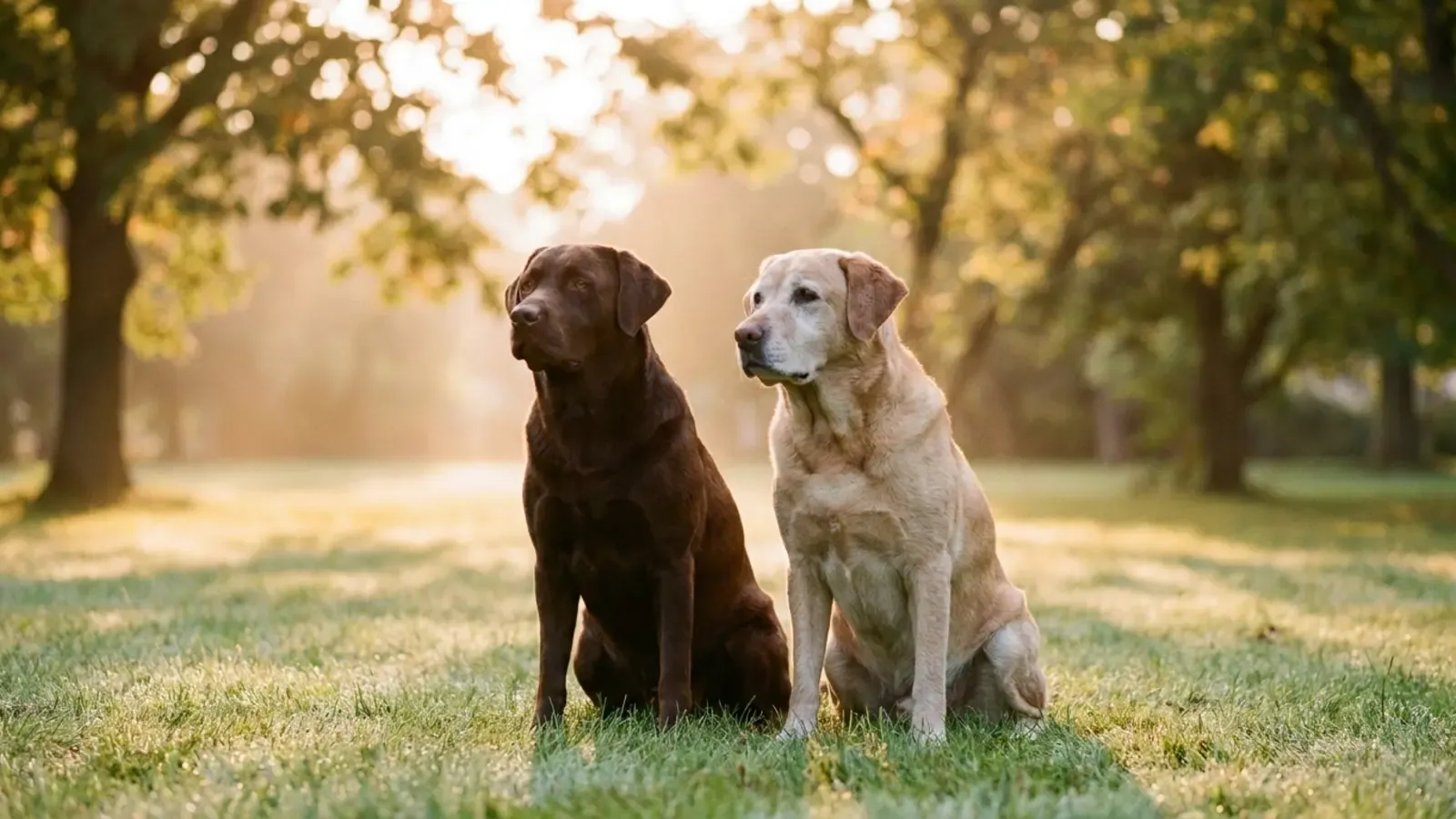
One dog year is not seven human years. A dog’s first year is roughly equal to 15 human years, the second adds about 9 more (so a 2-year-old dog is like a 24-year-old person), and after that each year adds about 4 to 7 human years, depending on size: small dogs age the slowest, giant breeds the fastest. So a 10-year-old Chihuahua is roughly 56 in human terms, while a 10-year-old Great Dane is closer to 78.
For a quick answer for your own dog, use the dog age calculator. The chart and the science are below.
Why the “times 7” rule is wrong
The seven-year rule probably came from comparing average lifespans: people living around 70, dogs around 10. It is easy to remember but gets almost every age wrong:
- It is far too low at the start. A one-year-old dog is sexually mature and nearly full grown, much more like a teenager than a 7-year-old child.
- It is too high for small dogs later on. A healthy 14-year-old terrier is not the equivalent of a 98-year-old.
- It ignores size. Across breeds, bigger dogs have shorter lives, so a Great Dane and a Jack Russell of the same age are at very different stages.
Vets and the American Veterinary Medical Association (AVMA) have said for years that dogs do not age at a rate of seven human years per year.
Dog age chart by size
This is the size-based chart widely used by vets, and it matches the estimates in the AVMA’s guidance for older pets. Find your dog’s age on the left and their adult weight across the top.
| Dog’s age | Small (up to 20 lb / 9 kg) | Medium (21–50 lb / 10–23 kg) | Large (51–90 lb / 23–41 kg) | Giant (over 90 lb / 41 kg) |
|---|---|---|---|---|
| 1 | 15 | 15 | 15 | 15 |
| 2 | 24 | 24 | 24 | 24 |
| 3 | 28 | 28 | 30 | 32 |
| 4 | 32 | 33 | 35 | 37 |
| 5 | 36 | 37 | 40 | 42 |
| 6 | 40 | 42 | 45 | 49 |
| 7 | 44 | 47 | 50 | 56 |
| 8 | 48 | 51 | 55 | 64 |
| 9 | 52 | 56 | 61 | 71 |
| 10 | 56 | 60 | 66 | 78 |
| 11 | 60 | 65 | 72 | 86 |
| 12 | 64 | 69 | 77 | 93 |
| 13 | 68 | 74 | 82 | 101 |
| 14 | 72 | 78 | 88 | 108 |
| 15 | 76 | 83 | 93 | 115 |
| 16 | 80 | 87 | 99 | 123 |
Ages are approximate human-year equivalents. Few giant breeds reach 12 or more, which is why their numbers run past 100.
The quick rule
If you don’t have the chart to hand, the rule of thumb usually quoted for a medium-sized dog is:
- Year 1 = 15 human years
- Year 2 = about 9 more (24 in total)
- Each year after = about 5 human years
For a small dog, use about 4 per year after age 2; for a large dog, about 5 to 6; for a giant breed, about 7.
Examples
- A 3-year-old Labrador (large) is about 30: a young adult in their prime.
- An 8-year-old Cocker Spaniel (medium) is about 51: middle-aged, and close to senior.
- A 12-year-old Yorkshire Terrier (small) is about 64.
- A 7-year-old Great Dane (giant) is about 56, already a senior dog.
The DNA formula: how scientists now measure dog age
In 2020, researchers at UC San Diego published a study in Cell Systems (Wang and colleagues) that compared dog and human ageing at the level of DNA. As we age, small chemical tags called methyl groups build up on our DNA in predictable patterns. This “epigenetic clock” ticks in dogs too.
The team read these patterns in blood samples from more than 100 Labrador retrievers, from puppies to 16-year-olds, and matched them against people. Their result:
human age ≈ 16 × ln(dog age) + 31
Here “ln” is the natural logarithm, the ln button on a scientific calculator. You don’t need the maths to see what it means: dogs age very fast at first and then slow down a lot. On this measure, a one-year-old dog is already like a 30-year-old person, and the curve flattens out after about seven.
| Labrador’s age | Human age (epigenetic formula) |
|---|---|
| 3 months | 9 |
| 6 months | 20 |
| 1 year | 31 |
| 2 years | 42 |
| 3 years | 49 |
| 4 years | 53 |
| 5 years | 57 |
| 6 years | 60 |
| 7 years | 62 |
| 8 years | 64 |
| 10 years | 68 |
| 12 years | 71 |
| 14 years | 73 |
| 16 years | 75 |
The formula lines up with real milestones: an 8-week-old puppy matches a human baby of about 9 months, when both are getting their first teeth, and the average Labrador lifespan of 12 years translates to about 70, close to average human life expectancy worldwide.
The limits of the formula
- It was built on one breed. The study used only Labradors. The authors note that breeds with very different lifespans could follow different curves, so it is a poor fit for a Chihuahua or a Great Dane.
- It is less exact in the middle years. The researchers found the match was close for infancy and old age but more approximate for adolescence and middle age.
- It doesn’t work for very young puppies. Below about 2 months the formula gives a negative number.
- It makes young dogs look older than the chart does. A 1-year-old is 31 by the formula but 15 by the size chart, because the two measure different things: one compares DNA changes, the other compares life stages and lifespans.
So which is right? Both are estimates. For an everyday sense of where your dog is in life, the size chart is the more practical tool, because it allows for the fact that big dogs live shorter lives.
What your dog’s “human age” is useful for
A number like “52 in human years” is fun, but it is most useful as a nudge:
- Senior care starts earlier than people think. Large breeds are seniors from about 8, giant breeds from about 6. That is when vets recommend check-ups twice a year. See senior dog care.
- Calorie needs change with age. An older, less active dog usually needs fewer calories. The dog calorie calculator adjusts for age and activity.
- A year is a long time for a dog. In an older dog, a year between vet visits is like five or more years for us, which is why small changes deserve attention.
Don’t know your dog’s real age?
If you adopted your dog as an adult, your vet can estimate their age from their teeth, eyes, coat and muscle tone. It is usually a range rather than an exact number. Our guide how to tell a dog’s age explains what vets look for.
PetTrackr helps you keep track. It is not veterinary advice: if your pet seems unwell, call your vet.