
How much to feed a cat
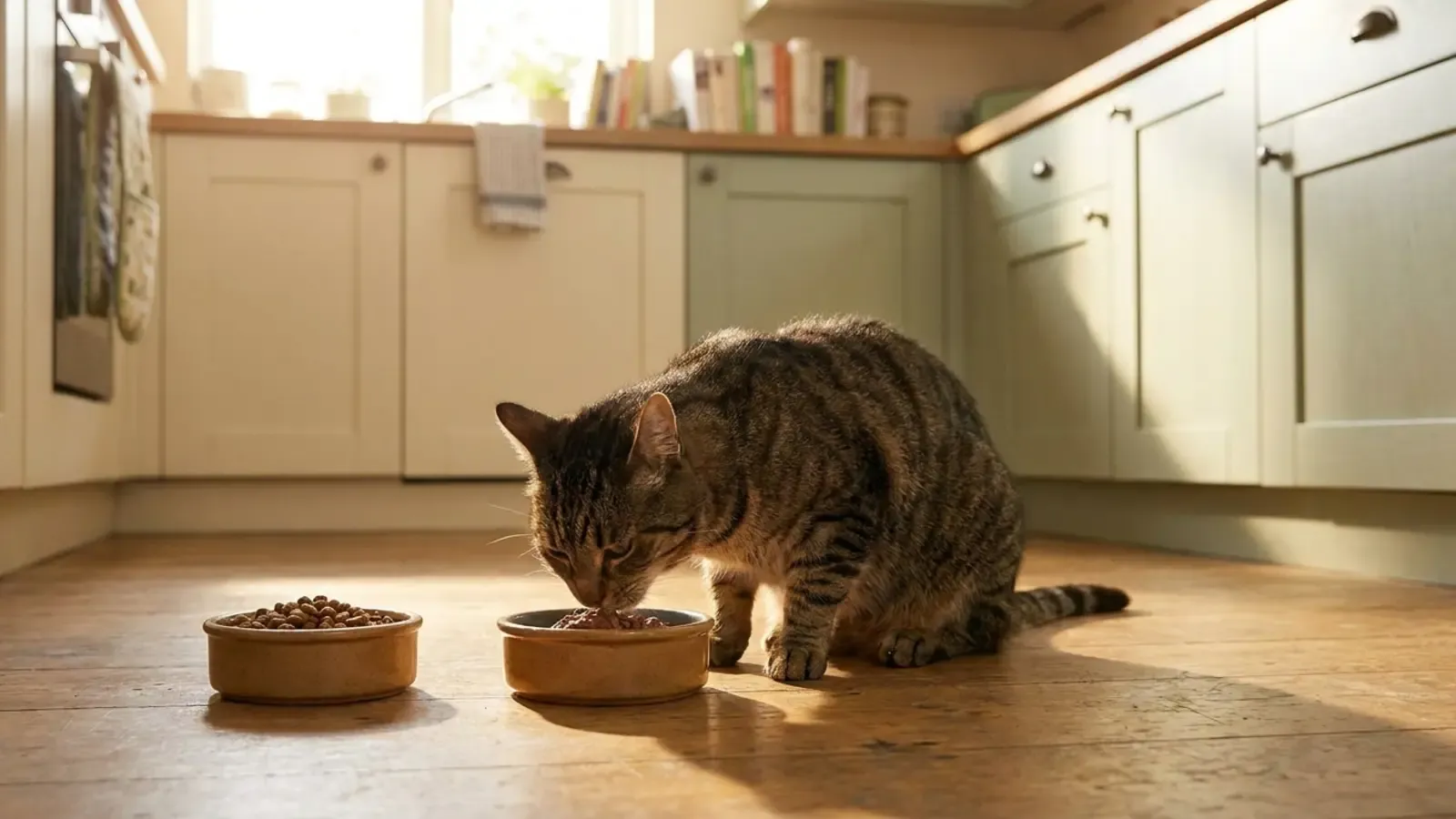
Most adult cats need about 200 to 300 kcal a day. A typical neutered, indoor cat weighing 4 kg (9 lb) needs roughly 240 kcal, which is about 60 to 70 g of dry food, or around two to three pouches of wet food, depending on the brand. Feed adults at least two meals a day, and kittens three to four.
The feeding guide on the pack is a fair start. Here is how to get closer for your own cat, how to split wet and dry, and how to check you’ve got it right.
How much to feed a cat, by weight
Vets estimate a cat’s daily calories from its resting energy requirement (RER), 70 × (weight in kg)0.75, multiplied by a factor for its life stage. The Merck Veterinary Manual suggests 1.2 for a neutered adult, 1.4 for an intact adult and 1.0 for a cat that gains weight easily. Use your cat’s ideal weight, not their current weight, if they are carrying extra.
| Cat’s ideal weight | Neutered adult (1.2 × RER) | Intact adult (1.4 × RER) |
|---|---|---|
| 2.5 kg (5.5 lb) | about 170 kcal a day | about 195 kcal a day |
| 3 kg (6.6 lb) | about 190 kcal | about 225 kcal |
| 3.5 kg (7.7 lb) | about 215 kcal | about 250 kcal |
| 4 kg (8.8 lb) | about 240 kcal | about 275 kcal |
| 4.5 kg (9.9 lb) | about 260 kcal | about 305 kcal |
| 5 kg (11 lb) | about 280 kcal | about 330 kcal |
| 6 kg (13.2 lb) | about 320 kcal | about 375 kcal |
Merck adds that any individual cat can need up to 30% more or less than a formula says. Our cat calorie calculator works it out for your cat’s weight and activity, and our guide to how many calories a cat needs explains the factors in more detail.
Turning calories into a portion
Find the calories on the label: usually kcal per kg for dry food and kcal per can or pouch for wet.
Dry food: grams a day = daily kcal ÷ kcal per kg × 1,000. A cat needing 240 kcal on a dry food with 3,800 kcal/kg needs about 63 g a day.
Wet food: pouches a day = daily kcal ÷ kcal per pouch. Wet foods vary a lot, so do the sum with your own brand rather than a rule of thumb.
Dry food is very energy dense, so a correct portion looks small. Weigh it on a kitchen scale rather than eyeballing a scoop: International Cat Care points out it only takes a couple of minutes, and a few extra kibbles a day is how many cats slowly gain weight.
Wet food, dry food, or both?
Both can be complete and balanced (the label will say so), and a cat can do well on either. They suit different things:
| Wet food | Dry food | |
|---|---|---|
| Water | About 70–80% water, which adds to what your cat drinks | Low in water; your cat needs fresh water always available |
| Calories | Fewer calories per mouthful, so a portion looks bigger | Energy dense, so it’s easy to overfeed |
| Convenience | Has to be eaten or cleared away, and opened packs go in the fridge | Can be left out and used in puzzle feeders |
| Cost | Usually more per day | Usually less per day |
Many vets and cat charities suggest a mix of both, which also stops a cat becoming fixed on one texture. If you mix, decide the split first and then halve each portion: for example, half the day’s calories as one wet pouch and the other half as a measured amount of dry. Feeding a full ration of each is the most common reason a mixed-fed cat gains weight.
Cats with urinary problems or kidney disease often benefit from more water in their diet, so your vet may recommend more wet food.
How many meals a day?
| Age | Meals a day |
|---|---|
| 8–12 weeks | At least 4 |
| 3–6 months | At least 3 |
| 6–12 months | At least 2 |
| Adult | At least 2. Several small meals suit many cats |
| Senior (10+ years) | As for adults, unless your vet advises otherwise |
Cats are natural snackers: left to themselves, they eat many small meals across the day and night. International Cat Care suggests dividing the daily ration into several small portions, using timed feeders or puzzle feeders if you are out. Cornell notes that most adults also do fine on one or two meals a day. Either way, the total for the day is what matters.
Free feeding
Leaving dry food out all day works for some cats, but many overeat. If you do it, measure the day’s amount into the bowl in the morning and don’t top it up. Replace any leftovers with fresh food daily.
Feeding kittens
Kittens need kitten food, which has more energy, protein and minerals for growth. Merck puts a kitten’s needs at about 2.5 × RER, and notes that kittens can also be fed free choice. In practice:
- Feed small meals often: at least four a day until 12 weeks, then at least three until 6 months.
- Offer both wet and dry so they get used to different textures.
- Keep fresh water out at all times. Cow’s milk isn’t needed, and many cats can’t digest it well.
- Weigh your kitten every week or two; they should gain steadily.
Most cats move to adult food at around 12 months. Neutering lowers a cat’s energy needs, so watch their shape closely in the months after the operation and trim portions if they start to fill out.
Is it the right amount?
Your cat’s body is the real answer. Every few weeks:
- Feel the ribs: you should feel them easily under a light layer of fat, without seeing them.
- Look from above: there should be a gentle waist behind the ribs.
- Look from the side: only a small belly pad, not a hanging tummy.
- Weigh them: a baby scale or the hold-your-cat-on-the-bathroom-scale trick both work.
If your cat is getting heavier, reduce the daily amount by about 10% and recheck in two to four weeks. If they need to lose more than a little, read how to help your cat lose weight first: cats must lose weight slowly.
Call your vet if your cat stops eating for more than a day, loses weight without a change in diet, or suddenly becomes much hungrier or thirstier than usual. These can be early signs of illness, and a cat drinking a lot of water is worth a check on its own.
If several people feed your cat, it is easy for breakfast to happen twice. In PetTrackr, each meal is logged against your cat’s daily calorie target and everyone in the household sees what has already been fed.
PetTrackr helps you keep track. It is not veterinary advice: if your pet seems unwell, call your vet.
 Foods toxic to cats
 How to help your cat lose weight